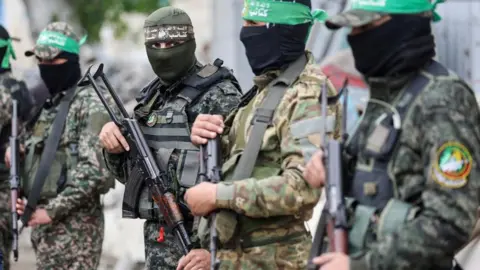
Hamas has rejected the disarmament plan of a top figure in President Donald Trump's Gaza peace efforts, a senior Palestinian official familiar with the negotiations has told the BBC.
He accused Nickolay Mladenov, the high representative for Gaza on the US-led Board of Peace, of bias towards Israel. Last month, Mladenov outlined a framework for Gaza's demilitarisation as part of the second phase of the ceasefire deal agreed by Hamas and Israel in October.
The official stated that Hamas informed regional mediators that it would not engage in talks on the second phase until Israel fully implemented the terms of the first phase.
Israel, meanwhile, maintains that it will not advance without progress on Hamas's disarmament.
A Hamas delegation in Cairo was due to meet Egypt's intelligence chief on Tuesday before departing.
The first phase of Trump’s peace plan halted the war, returned all Israeli hostages still held by Hamas in exchange for Palestinian prisoners, and involved a partial withdrawal of Israeli forces from Gaza.
In mid-January, US Middle East envoy Steve Witkoff announced the start of phase two, meant to lead to a permanent end to hostilities following Gaza's demilitarisation and a full Israeli withdrawal. However, there has been a deadlock between the two parties since then.
Mladenov recently laid out a detailed plan for Palestinian armed groups in Gaza to decommission their weapons, linking compliance to the start of reconstruction following Israel’s military campaign which devastated the territory.
The conflict escalated significantly on October 7, 2023, during a Hamas-led attack on Israel that resulted in approximately 1,200 deaths and many more taken hostage.
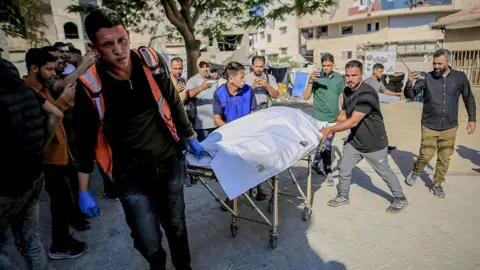
Since then, more than 72,330 people have been reported killed in Gaza due to Israeli military actions, including 757 since the ceasefire took effect on October 10, 2025, according to the territory's Hamas-run health ministry.
A senior Hamas official indicated to the BBC that they are awaiting a clear timetable from Mladenov for Israel to fulfill its remaining obligations under phase one, alongside guarantees to halt Israeli violations before discussing phase two.
Palestinian factions believe that the issue of disarmament must be part of a broader solution ensuring their right to self-determination rather than mere partial agreements.
They demand a total Israeli withdrawal from Gaza, coupled with the deployment of international protection forces to assist local policing efforts.
The official elaborated on the requirements of phase one, including completing military withdrawals, reopening crossings, ensuring the entry of sufficient aid, restoring utilities, and rehabilitating critical infrastructure.
Hamas officials criticize Mladenov's proposals as favoring Israeli positions, arguing they link all issues to disarmament without providing necessary funding for reconstruction, thereby halting recovery efforts.
Mladenov emphasized to the UN Security Council that disarmament could signify a decisive shift away from the cycles of violence that have long afflicted Gaza. He stressed the profound implications for Gazans, asserting the need for military withdrawal and significant reconstruction efforts.
Israel's Prime Minister, Benjamin Netanyahu, has threatened that Hamas will be disarmed "either the easy way or the hard way." The ongoing complex scenario continues to unfold as parties negotiate under increasing pressure.