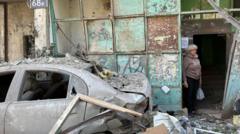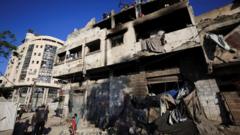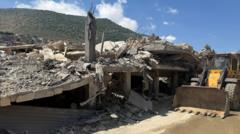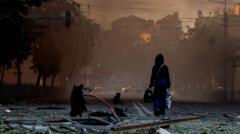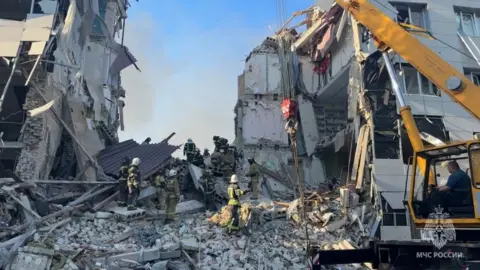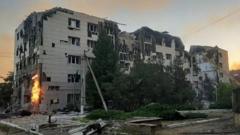
The rubble-strewn ruins of Starobilsk College of Luhansk Pedagogical University stand as a grim testament to the latest escalation in Ukraine's eastern front. Russian state television broadcasted footage of the five-story building reduced to charred debris, with rescuers carefully sifting through wreckage on May 23rd. A sign reading 'Starobilsk Professional College' still clings to the collapsed facade—a haunting marker of civilian tragedy.
Russian officials immediately seized on the destruction, accusing Ukraine of orchestrating a drone attack that killed 21 people and wounded 42. President Vladimir Putin condemned it as a 'terrorist strike,' insisting no military facilities existed nearby and denying Russian air defenses caused the damage. 'There is absolutely no basis for claiming the munitions struck the building as a result of our air defense or electronic warfare systems,' he stated.
Ukraine's General Staff contradicted the narrative, confirming an attack occurred near Starobilsk on May 21-22 but insisting it targeted Russian military units. 'We carried out an attack against a Russian military unit,' the statement declared, a claim that directly contradicts Moscow's account. The conflicting narratives escalated tensions to a global level as Russia demanded an emergency UN Security Council session.
Russia's UN ambassador Vasily Nebenyza presented photographs of the wreckage, declaring it 'a war crime' under international humanitarian law. The Danish representative countered with pointed criticism: 'If we apply the same logic, we'd need twice-daily emergency meetings to cover the terror inflicted across Ukraine by Russia.'
The diplomatic standoff came as Putin ordered defense ministry proposals for retaliation. Pro-Kremlin commentator Sergey Karaganov amplified the threat: 'We need to start punishing Europe... with symbolic strikes, then perhaps less symbolic ones.' This rhetoric echoes recent patterns of Russian escalation, with some analysts warning it could trigger wider regional conflict.
By late Saturday, emergency teams completed the search and rescue operation. Yet the image of survivor Olga Kovaleva, rescued after being trapped under rubble, remains etched in global memory. Her story—along with the 21 others who perished—highlights the brutal human cost of this conflict. As the UN debates Russia's demands, the world watches nervously for the next move in a war where civilian spaces are increasingly targeted.}
Russian officials immediately seized on the destruction, accusing Ukraine of orchestrating a drone attack that killed 21 people and wounded 42. President Vladimir Putin condemned it as a 'terrorist strike,' insisting no military facilities existed nearby and denying Russian air defenses caused the damage. 'There is absolutely no basis for claiming the munitions struck the building as a result of our air defense or electronic warfare systems,' he stated.
Ukraine's General Staff contradicted the narrative, confirming an attack occurred near Starobilsk on May 21-22 but insisting it targeted Russian military units. 'We carried out an attack against a Russian military unit,' the statement declared, a claim that directly contradicts Moscow's account. The conflicting narratives escalated tensions to a global level as Russia demanded an emergency UN Security Council session.
Russia's UN ambassador Vasily Nebenyza presented photographs of the wreckage, declaring it 'a war crime' under international humanitarian law. The Danish representative countered with pointed criticism: 'If we apply the same logic, we'd need twice-daily emergency meetings to cover the terror inflicted across Ukraine by Russia.'
The diplomatic standoff came as Putin ordered defense ministry proposals for retaliation. Pro-Kremlin commentator Sergey Karaganov amplified the threat: 'We need to start punishing Europe... with symbolic strikes, then perhaps less symbolic ones.' This rhetoric echoes recent patterns of Russian escalation, with some analysts warning it could trigger wider regional conflict.
By late Saturday, emergency teams completed the search and rescue operation. Yet the image of survivor Olga Kovaleva, rescued after being trapped under rubble, remains etched in global memory. Her story—along with the 21 others who perished—highlights the brutal human cost of this conflict. As the UN debates Russia's demands, the world watches nervously for the next move in a war where civilian spaces are increasingly targeted.}