In brief
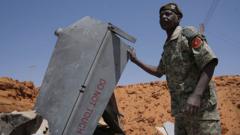
In a chilling turn of events, a Sudanese drone fired at a funeral procession at a cemetery in El-Obeid, killing four people and wounding others. Human rights groups Sudan Doctors Network and Emergency Lawyers attribute the attack to the Rapid Support Forces amid the ongoing proxy war. The city, now controlled by the army, sits at the center of Sudan’s three‑year conflict over power and resources, and is a critical oil‑rich zone where control determines national supply lines. With more than 11 million displaced and 28 million hungry, the war has become the world’s worst humanitarian crisis; experts estimate tens of thousands of deaths. Repeated strikes on civilian areas demonstrate a systematic pattern that threatens to turn El-Obeid into a war‑no‑stop zone.
In El‑Obeid’s cemetery, mourners watched a funeral procession turn into a battlefield when a drone launched an attack that killed at least four civilians and wounded several others. The strike poured a field of pain into an already ravaged city, where death and despair travel alongside warlords and combatants.
Both Sudan Doctors Network and Emergency Lawyers accuse the paramilitary Rapid Support Forces (RSF) of conducting the assault. Emergency Lawyers note that Wednesday’s first strike began a series of drone attacks, with casualties totalling 23 across the city.
El‑Obeid lies at a strategic crossroads in the oil‑rich Kordofan region, where the RSF controls western districts and the army dominates the east. Whoever governs the area effectively controls Sudan’s vital oil pipeline networks and, by extension, a large swathe of the country's resources.
The civil conflict, fuelled by leaders of the army and RSF splintering over the country’s future, has escalated into the worst humanitarian crisis on record. Reports put the death toll at around 50,000, with more than 11 million people displaced and 28 million facing acute hunger.
In addition to the cemetery attack, drones targeted a residential neighbourhood, an airport district and an army base. Five civilians died in earlier strikes, while a driver of a food supply truck was killed when his lorry was hit on Thursday, according to the two human‑rights groups.
Residents describe scenes of obliterated houses and collapsed roofs, noting that the devastation made survival impossible for many. "It is tragic. The roofs of houses collapsed on their occupants. When you look at some houses, you feel no one could have survived," said a resident to AFP.
The RSF has not commented on the latest strikes, leaving the international community in a state of acute uncertainty about who bears responsibility for these repeated assaults on civilians in El‑Obeid.