Machines mining minerals in the deep ocean have been found to cause significant damage to life on the seabed, scientists carrying out the largest study of its kind say.
The number of animals found in the tracks of the vehicles was reduced by 37% compared to untouched areas, according to the scientists.
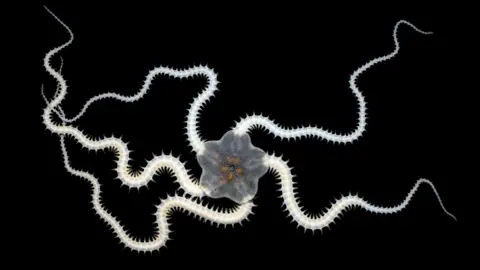
The researchers discovered more than 4,000 animals, 90% of which were new species, living on the seafloor in a remote area of the Pacific Ocean.
Vast amounts of critical minerals needed for green technologies could be locked in the deep ocean, but deep sea mining in international waters is very controversial and currently not permitted until more is known about the environmental impacts.
The research by scientists at the Natural History Museum in London, the UK National Oceanography Centre, and the University of Gothenburg was conducted at the request of deep-sea mining company The Metals Company.
Comparing biodiversity two years before and two months after the test mining, the team focused on animals sized between 0.3mm and 2cm, such as worms, sea spiders, and clams.
Dr. Eva Stewart, the lead author of the study, indicated that the mining machine disrupts the top sediment layer where most animals reside, leading to their removal.
Despite some species possibly moving away from the impacted area, Dr. Guadalupe Bribiesca-Contreras expressed concerns about pollution potentially harming less resilient species.
The findings present a dilemma as the demand for the minerals, essential for renewable energy technologies, continues to grow, with the International Energy Agency predicting that demand may double by 2040.
As nations grapple with the balance between resource extraction and environmental preservation, the future of deep-sea mining remains uncertain.