Deputies in the Italian parliament have voted unanimously to introduce the crime of femicide – the murder of a woman, motivated by gender – as a distinct law to be punished with a life sentence.
In a symbolic move, the bill was approved on the day dedicated to the elimination of violence against women worldwide.
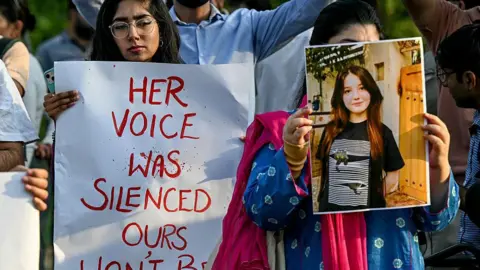
The idea of a law on femicide had been discussed in Italy before but the murder of Giulia Cecchettin by her ex-boyfriend was a tragedy that shocked the country into action.
In late November 2023, the 22-year-old was stabbed to death by Filippo Turetta, who then wrapped her body in bags and dumped it by a lakeside.
The killing was headline news until he was caught, but it was the powerful response of Giulia's sister, Elena, that has endured. The murderer was not a monster, she said, but the healthy son of a deeply patriarchal society. They were words that brought crowds out across Italy demanding change.
Two years on, MPs have voted for a law on femicide after a long and passionately debated session of parliament. It makes Italy one of very few places to categorize femicide as a distinct crime.
Introduced by Prime Minister Giorgia Meloni, the law was backed by her own hard-right government as well as opposition MPs. Many wore red ribbons or red jackets to remember the victims of violence.
From now on, Italy will record every murder of a woman that is motivated by her gender as femicide. Judge Paola di Nicola, one of the authors of the new law, described its significance, stating that femicides will be classified, studied in their real context, and brought to light.
The law will apply to murders which are an act of hatred, discrimination, domination, control, or subjugation of a woman as a woman, or that occur when a woman breaks off a relationship or seeks to limit her freedoms.
The legislation has faced some criticism regarding its vagueness and potential challenges in proving gender motivations in court, yet many believe it is a crucial step toward addressing gender-based violence.
Overall, the approval of this law by 237 deputies highlights a united political front against violence toward women, signaling a burgeoning societal acknowledgment of the deep-rooted issues surrounding gender violence in Italy.