In brief
China’s rapid rise in electric vehicle production, advanced battery tech, and software‑driven design is reshaping the global automotive market, forcing foreign automakers to rethink partnerships and production strategies.
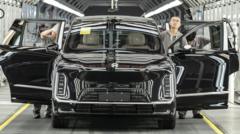
The 2026 Auto China show in Shanghai exposed a hard truth for Western carmakers: Chinese competitors now lead not only in electric vans but in the whole ecosystem of mobility, from batteries and manufacturing to software, robotics and autonomous tech.In Beijing and Hefei, the BBC team walked through factories that look almost futuristic – robots moving cars every 76 seconds, software teams coding in real time, and quality control cells that perform each test in a single sweep. The pace and precision make the oldest engines a contrast: many familiar brands such as GM, Volkswagen and Toyota are scrambling to keep up.Japanese executives are openly admitting defeat. Honda’s chief executive Toshihiro Mibe said he has “no chance against this” in a Shanghai plant, while Ford’s Jim Farley warned that Western brands are “fighting for our lives” as Chinese firms expand abroad.The reason for China’s dominance is multi‑layered. State‑backed subsidies have poured billions of dollars into EV and battery manufacturing, enabling Chinese producers to ship small electric SUVs at a third of the cost of making them in the west. As reported by the International Energy Agency, China’s supply chain is so integrated that a battery can be made, assembled and sold within days.Beyond the cars themselves, the country is creating an entire ecosystem – 315+ product categories are exported, with a significant share tied to EVs, from battery cells to manufacturing machinery. Tech giants like Xiaomi, Huawei and Alibaba now have their own electric‑vehicle lines, and they bring their smartphones, cloud platforms and AI expertise to the auto industry.Xiaomi’s first EV, launched in 2024, already sells in large volumes, while BYD offers ultra‑fast charging that adds 400 km of range in five minutes. XPeng is venturing into humanoid robots and flying cars on top of its electric‑vehicle business, while He Xiaopeng emphasizes that the next decade will see “any car company as a robotics company.”In China, foreign brands that once dominated – GM, VW, Toyota – are losing market share. From 64 % of the Chinese market in 2020 to just 32 % today, the fall in sales has hit earnings hard and forced companies to redesign product lines. Luxury names are under pressure too: Huawei’s Maextro S800 has become the best‑selling new‑model sedan above £70k, outselling Porsche and BMW combined.The relationship model is shifting. Stellantis is partnering with state‑backed Dongfeng to produce Peugeot and Jeep models that will reach both China and Europe. VW has bought $700 million of XPeng’s autonomous‑driving software, a technology it could not develop fast enough on its own. Across the board, manufacturers are investing abroad in research units that draw on Chinese talent so they can co‑design rather than just co‑manufacture.Yet, there are risks. Bosch’s automaker see a steep decline in China’s domestic demand, amid an over‑capacity battle and a slowing economy. Chinese brands are increasingly exporting, facing tariffs of 45–100 % in Europe and the US, but they are still proving resilient. The US remains largely closed to Chinese imports, yet for every market locked out, a new one opens.The broader implication is that as the center of gravity shifts to Asia, manufacturing hubs in Europe and Southeast Asia – the ones that have historically supplied the industry – may have to pivot. Jobs and local supply chains could be affected as the global automotive “brain” recalibrates.In short, the chasm between the West and China is widening. Those who cooperate with Chinese innovation will thrive next to the current leaders in mobility. Those who refuse to collaborate risk being left behind in a market that is moving too fast to treat them as legacy competitors.