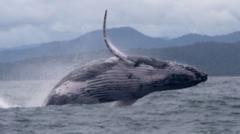
In brief
A humpback whale has completed one of the longest migrations on record, raising concerns about climate change's role in altering whale behavior and food availability.
Despite being a highly migratory species, the recent journey of a humpback whale spotted off Colombia and later near Zanzibar has astonished scientists due to its extraordinary length. The whale made the remarkable trip of at least 13,000 kilometers, prompting researchers to speculate that climate change might be depleting available food or pushing the mammals to seek new breeding opportunities.Dr. Ekaterina Kalashnikova from the Tanzania Cetaceans Program emphasized how extraordinary this migration is, stating, "It’s truly impressive and unusual even for this highly migratory species." Captured in 2017 off Colombia's Pacific coast, the whale re-emerged in 2022 near the coast of Zanzibar, garnering attention for the unprecedented distance traveled.The typical behavioral patterns of humpback whales include annual migrations between warm breeding grounds and nutrient-rich feeding waters in cooler areas. However, this individual whale's journey included two significantly spaced breeding grounds, leading experts to believe it might represent the longest documented migration of a humpback whale.One hypothesis suggests that climate change is impacting krill populations—the primary food source for humpbacks—thereby compelling them to travel further distances in search of sustenance. Additionally, conservation efforts may be prompting greater exploration for new breeding grounds.Dr. Kalashnikova noted, "While the exact reasons behind these movements remain unclear, potential contributors could include global climate changes, increased frequency of extreme environmental events, and evolutionary adaptations.” The whale was first observed in 2013 and was identified again in 2017 and 2022. Its journey, according to scientists, was meticulously tracked using numerous photographs submitted through the citizen science platform, happywhale.com. This database employs artificial intelligence to analyze specific patterns on individual whale flukes, thus helping researchers map their global movements. The findings have been published in the journal Royal Society Open Science.For those interested in the secret lives of humpback whales, "Secrets of Antarctica's Giants" can be viewed on BBC iPlayer. Further insights into climate changes affecting nature are available through the Future Earth newsletter from BBC's Climate Editor, Justin Rowlatt.