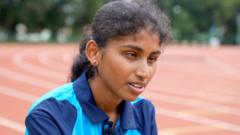
Rakshitha Raju, a 24-year-old Indian para athlete, reflects on her journey defying societal expectations despite being born blind. In her early years, villagers dismissed her potential, but with the encouragement of her sports teacher, she discovered athletics. The guide runner system allowed her to harness her talent, leading her to compete in prestigious events, including the Paralympics.
Raised in a remote village in southern India after losing both parents by age 10, Rakshitha was brought up by her grandmother, who is hearing and speech impaired. Their shared understanding of disability fostered a deep connection throughout her life. Motivated by a teacher's belief in her potential as an athlete, Rakshitha initially struggled with the thought of how to run with visual impairment.
The guide runner system gave her hope and pushed her to excel in sports. In 2016, she met Rahul Balakrishna, a middle-distance runner who took on the dual role of guide and coach, paving the way for her to access better training facilities in Bangalore. They developed a close bond over the years, with Rakshitha stating, “I believe in my guide runner more than myself.”
Since then, the duo has achieved remarkable successes, winning gold medals at the Asian Games in 2018 and 2023. Their triumphs were celebrated in Rakshitha's village, a stark contrast to the dismissive comments she faced as a child. Rakshitha made history as the first blind Indian woman to qualify for the Paralympic 1500m event, competing in Paris in 2024.
Another inspiring athlete, Simran Sharma, partially sighted like Rakshitha, embarked on a similar journey, requiring a guide runner after realizing her limitations during the Tokyo Paralympics. After some initial challenges, Simran and her guide Abhay Kumar formed a successful partnership, earning silver in the 200m at the recent Paralympics.
Both athletes face challenges regarding their guide runners' future, with calls for more support from the Paralympic Committee of India for the guides. Simran and Rakshitha hope to inspire the next generation of athletes with disabilities. As they aim for new heights in their respective sports, both plan to return to future Paralympics, aiming to change the narrative surrounding their medals and experiences.
Raised in a remote village in southern India after losing both parents by age 10, Rakshitha was brought up by her grandmother, who is hearing and speech impaired. Their shared understanding of disability fostered a deep connection throughout her life. Motivated by a teacher's belief in her potential as an athlete, Rakshitha initially struggled with the thought of how to run with visual impairment.
The guide runner system gave her hope and pushed her to excel in sports. In 2016, she met Rahul Balakrishna, a middle-distance runner who took on the dual role of guide and coach, paving the way for her to access better training facilities in Bangalore. They developed a close bond over the years, with Rakshitha stating, “I believe in my guide runner more than myself.”
Since then, the duo has achieved remarkable successes, winning gold medals at the Asian Games in 2018 and 2023. Their triumphs were celebrated in Rakshitha's village, a stark contrast to the dismissive comments she faced as a child. Rakshitha made history as the first blind Indian woman to qualify for the Paralympic 1500m event, competing in Paris in 2024.
Another inspiring athlete, Simran Sharma, partially sighted like Rakshitha, embarked on a similar journey, requiring a guide runner after realizing her limitations during the Tokyo Paralympics. After some initial challenges, Simran and her guide Abhay Kumar formed a successful partnership, earning silver in the 200m at the recent Paralympics.
Both athletes face challenges regarding their guide runners' future, with calls for more support from the Paralympic Committee of India for the guides. Simran and Rakshitha hope to inspire the next generation of athletes with disabilities. As they aim for new heights in their respective sports, both plan to return to future Paralympics, aiming to change the narrative surrounding their medals and experiences.