In brief
During his recent visit to China, Vladimir Putin was warmly welcomed by Xi Jinping, showcasing their ongoing partnership and strategic cooperation. However, despite discussions on the Power of Siberia 2 pipeline, no concrete deal was reached, emphasizing that while their personal rapport appears strong, geopolitical realities may limit progress in their relationship.
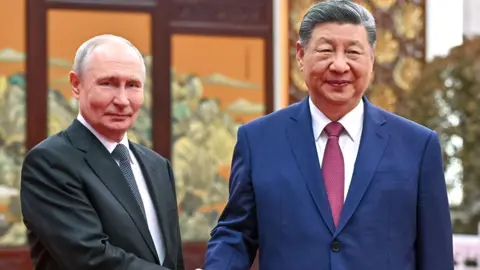
For a moment you could have mistaken Beijing for Moscow. As Vladimir Putin and Xi Jinping walked the red carpet towards the Great Hall of the People, a Chinese military band played the romantic Russian classic Moscow Nights. 'If only you knew how these Moscow Nights are dear to me,' goes the refrain. Hidden in the notes, was there a hint of political romance? Even bromance...? 'My dear friend,' said Putin to Xi. 'My old friend,' said Xi to Putin. This warmth reflects a relationship cultivated over more than 40 meetings over the years.In public statements, both leaders spoke of 'strategic cooperation,' 'partnership,' 'mutual respect,' 'friendship,' and 'trust.' Together, they criticized the 'irresponsible' nuclear policy of the United States, condemning Donald Trump's plans for a missile defense shield. Just prior to the summit, a Russian government newspaper featured contrasting images: one of a solitary Trump and another showcasing Putin and Xi together, signaling their solidarity.However, within the arena of geopolitics, relationships tend to be governed by self-interest rather than affection. The summit underscored inherent limitations to their partnership, particularly in energy relations, where Russia seeks to finalize the Power of Siberia 2 pipeline deal. Although both countries signed a memorandum for the project last year, China is evidently cautious, possibly to avoid over-reliance on Russian gas supply. Discussions concluded with a 'general understanding on the parameters' of the pipeline but no final agreement was reached – disappointing yet unsurprising for Russian officials.While both nations are aligned on numerous fronts, expert commentary emphasizes that 'the positions of Russia and China are not identical. Their interests do not always coincide,' highlighting the complexities and nuances of their relationship in the broader context of international dynamics.