In brief
Putin received a ceremonial welcome in Beijing featuring Moscow Nights music and warm exchanges with Xi Jinping, yet returned home without a finalized agreement for the Power of Siberia 2 gas pipeline. China's hesitation over pricing and strategic energy dependencies contrasts with Russia's urgent need to offset European market losses, exposing the complex reality of their 'strategic partnership' where mutual interests diverge.
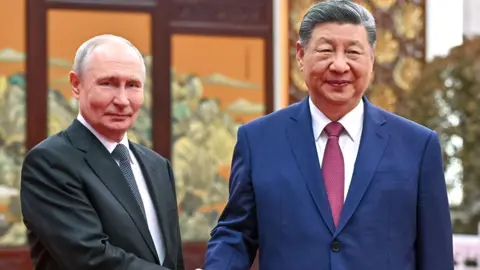
As Russian President Vladimir Putin entered Beijing's Great Hall of the People flanked by a Chinese military band playing 'Moscow Nights', the symbolism was unmistakable. The lyrics, 'If only you knew how these Moscow Nights are dear to me,' echoed the dramatic public display of camaraderie between Putin and Xi Jinping. Their handshake, the Russian leader calling Xi 'my dear friend' and the Chinese leader replying 'my old friend', captured more than 40 years of diplomatic dance. Yet beneath the romantic narrative lay geopolitical realities Russia and China cannot ignore.This summit revealed the delicate balance of their 'strategic partnership'. While both leaders praised 'mutual respect' and 'trust', their positions on critical issues remain fundamentally divergent. Russia's push for the Power of Siberia 2 pipeline—a vital project to offset European market losses—faces China's calculated hesitation. Beijing has repeatedly raised concerns about pricing structures and the risk of over-reliance on Russian energy, preferring a diversified supplier base.The Kremlin's official position was revealed in a telling editorial: 'The positions of Russia and China are not identical. Their interests do not always coincide.' This admission appeared alongside a striking juxtaposition—Putin and Xi walking side-by-side, contrasted with Trump's isolated image on Air Force One from his recent China trip. The visual messaging was clear: Russia and China are now strategic partners, but not interchangeable.Contrasting with fleeting 'bromances', the Russia-China relationship has endured decades of complex interdependence. Yet the pipeline stalemate demonstrates even the closest partnerships have limits. Putin's foreign policy aide Yuri Ushakov's dismissal of the 'spirit of Anchorage'—the hopeful posturing after his Alaska meeting with Trump—highlights the stark reality: the Ukraine war remains unresolved, and the US-Russia thaw is a fading memory.As Putin departed Beijing, the symbolic farewell masked a strategic truth: Russia's energy ambitions require China, but China's economic caution makes finalizing such deals difficult. The pipeline remains 'a general understanding' without commitment—proof that in geopolitics, even warm handshakes cannot overcome differing national interests. The world now watches as these two nuclear powers navigate their complex dance, where romance is the backdrop and pragmatism dictates the steps.}