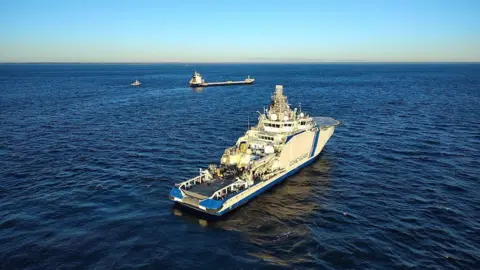
Finnish police have detained a vessel suspected of damaging an undersea telecoms cable running from Helsinki to Estonia across the Gulf of Finland.
The cargo vessel, the Fitburg, was sailing from St Petersburg to the port of Haifa in Israel, under the flag of St Vincent and Grenadines.
All 14 crew members were arrested after the cable, owned by Finnish telecom operator Elisa, was damaged. The operator stated that the damage had 'not affected the functionality of Elisa's services in any way', and that services had been re-routed.
The police are investigating allegations of 'aggravated disruption of telecommunications' and 'aggravated sabotage and attempted aggravated sabotage'.
The detained crew members included individuals from Russia, Georgia, Kazakhstan, and Azerbaijan.
Undersea cables are vital for international communications and data transfer, and the Baltic Sea has witnessed numerous incidents in recent years involving damage to these cables.
On Wednesday morning, Finnish authorities dispatched a helicopter and a patrol ship to investigate the anchored vessel, which was reportedly dragging its anchor in the sea.
After telecom provider Elisa detected a fault, operations were launched to assess the damage.
The Finnish police confirmed that 'the authorities had taken control of the vessel as part of a joint operation.'
The police clarified their investigations concerned aggravated criminal damage and interference with telecommunication services.
President Alexander Stubb communicated Finland's preparedness to address various security challenges via social media.
When questioned by journalists, police chief Ilkka Koskimäki refrained from speculating on whether the cable damage was part of an orchestrated effort by another nation.
Eight NATO countries border the Baltic Sea, including Finland and Estonia, and local media reported a second telecom cable linking Estonia and Finland also experienced an outage the same day. Estonia's president expressed hope that the incident was not intentional, pending investigations.
The European Commission is closely watching the incident, signaling readiness to counter hybrid threats, a term increasingly used to describe acts perceived as subversive operations amid geopolitical tensions, especially following Russia's invasion of Ukraine in 2022.
Finnish MP Jarno Limnell referred to the situation as a national security concern, emphasizing the importance of securing critical infrastructure.
}