In brief
The world’s first wooden satellite, LignoSat, was launched to study timber's potential use in space missions, paving the way for innovative approaches in future lunar and Martian colonies.
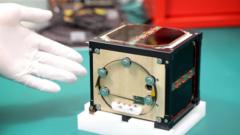
The world's inaugural wood-panelled satellite has officially embarked on its mission, aimed at assessing the viability of using timber as a sustainable resource for future space exploration. Developed by a team of researchers in Japan, this innovative satellite, named LignoSat after the Latin term for wood, measures just 900 grams and is set to travel to the International Space Station via a SpaceX launch. Once in place, it will be released into low Earth orbit for a six-month evaluation.LignoSat features panels crafted from the magnolia tree, employing traditional techniques that avoid screws and glue. The project, led by Kyoto University, envisions a future where renewable resources like wood could help replace metals in some aspects of space exploration. "Wood is more resilient in space because it's devoid of moisture and oxygen, which often lead to decay or combustion," explained Koji Murata, a professor of forest science at Kyoto University. He noted parallels with early 20th century aircraft that utilized wood, positing that a wooden satellite is indeed plausible.The researchers also dream of future scenarios where wood could be cultivated on planetary bodies like the Moon or Mars, providing essential materials for upcoming space colonies. The satellite integrates classic aluminum structures alongside its wooden components and is equipped with sensors designed to collect data on how timber reacts to the harsh conditions of space during its orbital mission.Dr. Simeon Barber, a space research scientist from the Open University in the UK, pointed out that while this satellite isn’t constructed entirely from wood, the underlying concept is intriguing. "From a sustainability standpoint, wood is a renewable resource that can potentially support human endeavors on other planets," he emphasized.While wood’s properties could pose engineering challenges, especially regarding strength predictions needed in spacecraft construction, the Kyoto University researchers advocate for a shift towards less environmentally damaging materials. The team believes that wooden structures could produce fewer pollutants upon re-entry into Earth's atmosphere, addressing the growing concerns about space debris.Despite these possibilities, Dr. Barber warned that introducing wood into spacecraft design might complicate weight considerations. As the global space industry faces mounting scrutiny over its environmental impact, the research team remains hopeful that employing timber could pave the way for innovative and sustainable materials in future space exploration efforts.