In brief
The JAXA‑led Mars Moons Exploration (MMX) craft has lifted off from Tanegashima to land on the small moon Phobos, collecting a 10 g sample for Earth analysis. If the samples return in 2031, it will be the first time any material from Mars or its moons is examined in a lab. Scientists hope the dust will resolve competing theories about the moons’ origins and may even contain particles from Mars itself. The mission follows years of attempts to bring Martian samples back, including NASA’s Perseverance rover and China’s planned mission.
Mission blasts off for Mars to grab a piece of its moon
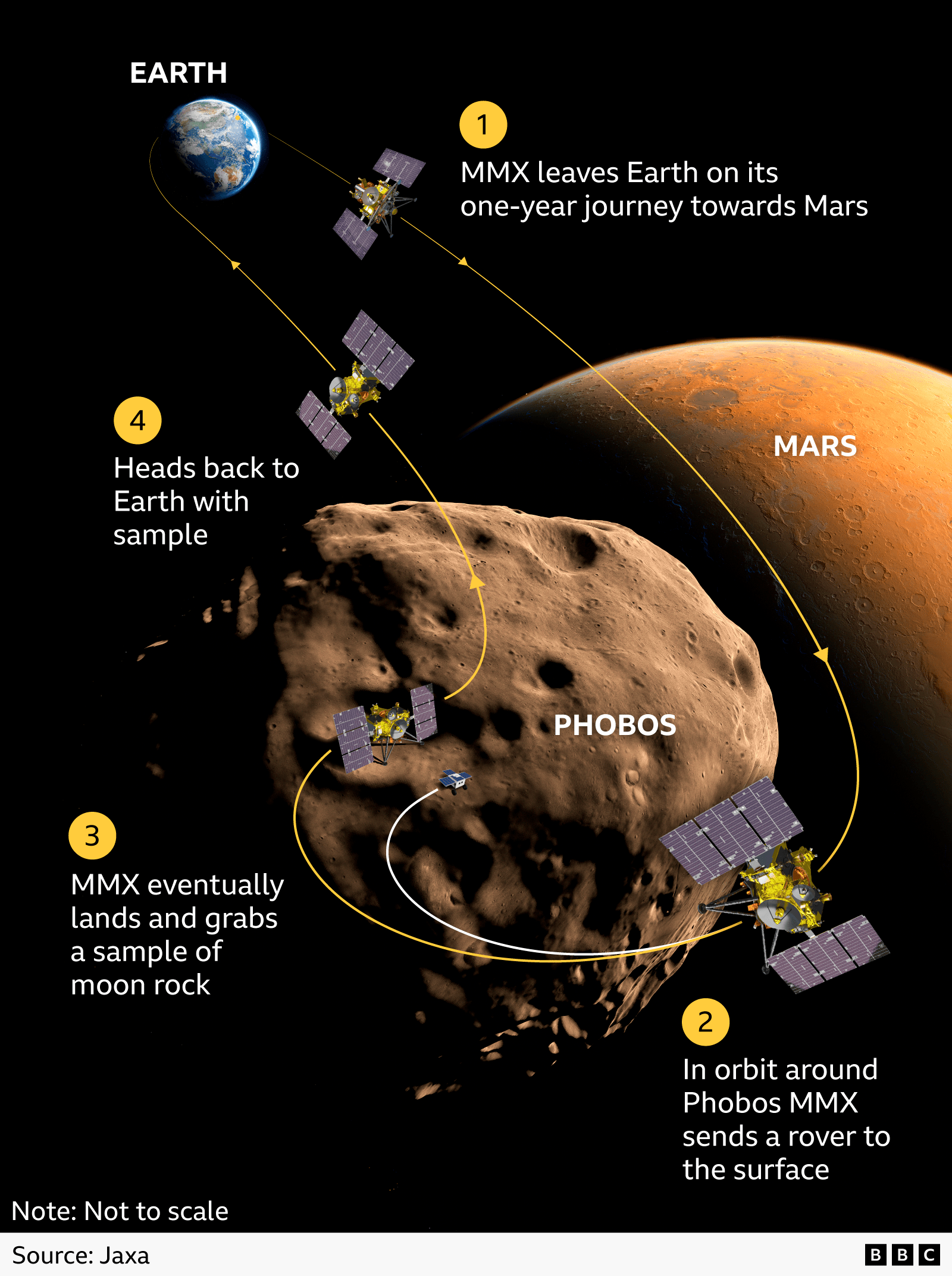
A Japanese spacecraft has lifted off from the Tanegashima Space Center, heading toward Mars’s small moon, Phobos, in order to collect a sample of lunar dust and bring it home for analysis.
If successful, it will be the first time a sample is returned from Mars or its moons, shedding scientists light on the origin of Phobos and Deimos.
The spacecraft is scheduled to arrive at Phobos in August 2027 and will study Deimos on its way before focusing on the larger moon. A small rover will land on Phobos, scout a site and deploy a robotic arm and samplers to collect dust.
The collected material, a tiny 10 g capsule, will arrive on Earth in 2031, landing in the Woomera desert of South Australia. Although small, the sample will allow detailed chemical and mineralogical studies that are impossible with meteorites, which become contaminated on Earth.
Prof. Sara Russell of the Natural History Museum noted the ambition of the mission, adding that the sample may contain Mars‑impacted grains due to Phobos’s proximity to the planet. This could directly inform researchers about Mars’ surface history.
The ouster of NASA’s Mars Sample Return and China’s forthcoming mission highlight the global race for pristine Martian material. The MMX mission provides a unique opportunity to access moon dust before other programmes, potentially unlocking new planetary science insights.