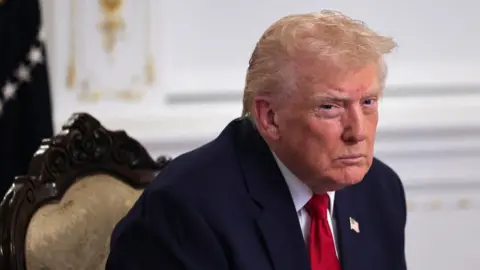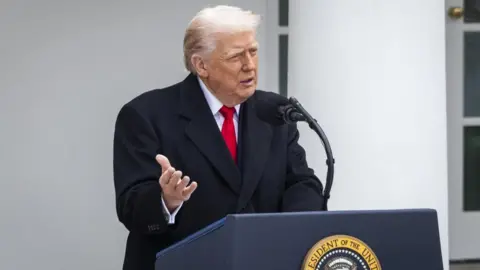
The World Trade Organization (WTO) has revealed that global trade is expected to shrink in 2023 due to a series of tariffs introduced by US President Donald Trump. The organization cautioned that "severe downside risks," such as retaliatory tariffs and ongoing political uncertainty, may exacerbate the situation, resulting in a potential reduction of over 10% in trade within North America alone.
Ngozi Ikonjo-Iweala, the WTO Director-General, expressed her concerns regarding the increasing separation between the US and China, labeling it a "worrying phenomenon." Initially expecting an expansion of global goods trade by 2.7% in 2025, the WTO has lowered its forecast to a decline of 0.2%. Chief economist Ralph Ossa emphasized that trade policy uncertainty created by tariffs significantly dampens trade activity, leading to reduced exports and economic activity.
As of April 5, a baseline tariff of 10% on numerous foreign imports to the US came into effect, although some countries and specific goods enjoy exemptions. Conversely, China is facing a far heavier tariff burden at 145% on most imports.
On Wednesday, the US stock market reacted negatively, with major indexes witnessing a decline amidst the uncertainty. Despite the anticipated drop in trade with the US, the WTO remains optimistic about regional trade growth in Asia and Europe, projecting modest increases in both exports and imports.
Moreover, for the first time, the WTO's report includes a forecast for services trade (trading of services rather than goods), which is anticipated to grow by 4% by 2025, a slight drop from previous expectations.
Since taking office in January, President Trump has made numerous announcements regarding tariffs, which he argues will encourage consumers to purchase American-made products, boost tax revenues, and attract considerable investments into the US. Critics, however, point out the complexities involved in revitalizing manufacturing and suggest that any economic benefit would take decades to materialize.
In a notable reversal, Trump recently paused tariffs affecting nearly 60 trading partners—excluding China—after facing opposition from politicians and market forces. Meanwhile, the Bank of England's governor has warned that Trump's tariffs may adversely affect UK consumer spending.