In brief
At a forum held in Dubai on 5 November 2026, the Zayed International Foundation for the Environment, together with ASHRAE Falcon Chapter UAE and Curtin University Dubai, underlined that indoor environmental quality (IEQ) must be a primary metric for sustainable buildings, complementing energy efficiency. The event showcased smart technologies, AI monitoring and low‑carbon solutions that can create healthier indoor spaces, and called for stronger collaboration among academia, industry and government.
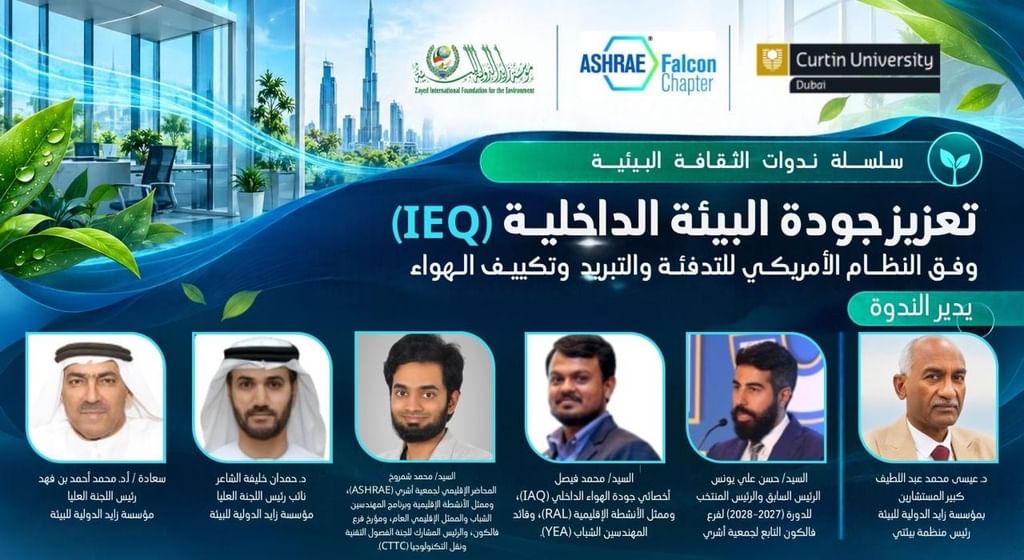
In Dubai on 5 November 2026, the Zayed International Foundation for the Environment hosted a seminar in partnership with the ASHRAE Falcon Chapter UAE and Curtin University Dubai to highlight indoor environmental quality (IEQ) as a fundamental pillar of sustainability. The session, themed “Advancing Indoor Environmental Quality in Accordance with American Standards,” drew experts, professionals and policy makers to explore how healthy indoor spaces can enhance human wellbeing while supporting energy‑efficient building practices.
Chairman Mohammed Ahmed bin Fahad of the Foundation’s Higher Committee opened the event by stressing that the value of a sustainable building can no longer be measured solely by its energy performance. He said the true worth lies in providing safe, healthy environments that improve occupants’ health, productivity and overall wellbeing. “Sustainable buildings must now look to human health as part of their defining metric, not just energy use,” Fahad noted during his remarks.
During the workshop, Hassan Ali Younes, former president of the ASHRAE Falcon Chapter and president‑elect of the 2027‑2028 term, presented IEQ as an integrated framework that includes indoor air quality, thermal comfort, lighting, acoustics, water quality and humidity management. Younes highlighted recent studies that demonstrate a direct relationship between indoor environmental conditions and occupants’ performance, health and wellbeing. He said that ASHRAE standards play a pivotal role in providing scientific guidelines for healthy and sustainable indoor environments.
The seminar showcased several smart‑technology solutions aimed at improving IEQ. Speakers described how artificial‑intelligence monitoring systems can track real‑time data from sensors dispersed throughout a building to identify air‑pollution events, temperature fluctuations or acoustic anomalies. These systems then trigger automated responses—such as adjusting ventilation rates or altering lighting levels—to keep indoor conditions within optimal ranges. Low‑carbon building materials and renewable energy integration were also highlighted as complementary strategies that can reduce overall environmental footprints while sustaining occupant health.
Experts at the event urged that achieving IEQ goals requires robust collaboration among academia, industry and government. The Foundation’s statement called for stronger partnerships that embed IEQ considerations into future sustainable city planning and urban development. It also emphasized that the late Sheikh Zayed bin Sultan Al Nahyan’s legacy of environmental stewardship continues to inspire national sustainability efforts across the United Arab Arabia.
Attendees concluded the forum with a call to action: every new building must be designed with IEQ metrics at the core of its sustainability assessment. The Foundation committed to continue its outreach and to work with the International Organization for Standardization (ISO) and other global bodies to promote healthy indoor environments worldwide.