In brief
A PhD student in the US stumbled upon the lost Maya city of Valeriana using Lidar technology, revealing a complex network of structures and challenging perceptions of ancient urbanization amid the Mexican jungle.
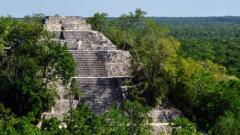
A remarkable discovery has emerged from the jungles of Mexico, where a large Maya city, named Valeriana, has been uncovered centuries after it was lost to the dense foliage. Archaeologists exploring the state of Campeche found numerous ancient structures, including pyramids, sports fields, and amphitheatres, thanks to advanced Lidar technology that allows mapping of hidden environments.The city, believed to have once supported a population of 30,000 to 50,000 people during its zenith from 750 to 850 AD, showcases an architectural complexity second only to Calakmul, a premier site in ancient Latin America. The accidental revelation of Valeriana occurred when Luke Auld-Thomas, a PhD student from Tulane University, serendipitously came across a Lidar survey conducted by a Mexican environmental agency.This remote sensing technique uses lasers fired from an aircraft to detect and map surfaces beneath tree canopies, facilitating the discovery of significant historical sites. Auld-Thomas noted that upon analyzing the survey data with archaeological methodologies, he uncovered a vast city landscape that had largely been overlooked.Named after a nearby lagoon, Valeriana contradicts traditional Western views that equate the Tropics with decay and abandonment of civilizations. Instead, scholars emphasize the rich cultural heritage that thrived in this region. The cause of the city's eventual decline remains uncertain, but climate change is attributed as a significant contributing factor.Though no photographs of the city exist, it is reported to have pyramid structures akin to those in nearby Calakmul. Proximity to modern settlements means Valeriana's ruins are “hidden in plain sight,” lying just a short hike from a major road in the present-day community of Xpujil.The ancient city spans approximately 16.6 square kilometers and includes two prominent centers about 2 kilometers apart, interlinked by a network of houses and causeways. Among the finds are plazas featuring temple pyramids, a ballgame court, and evidence of a reservoir that signals extensive urban planning to accommodate a large populace.Professor Elizabeth Graham of University College London, who was not involved in the study, confirms that the findings support the notion of densely populated and organized Maya cities rather than isolated communities. As the research demonstrates, urban centers like Valeriana had to face devastating population pressures exacerbated by climatic challenges, suggesting that the eventual societal collapse following 800 AD could have stemmed from a lack of adaptability to worsening droughts.Profound advancements in Lidar technology are opening new horizons for archaeology, particularly in covered terrains like the Tropics. With just a decade of application revealing numerous ancient sites, researchers anticipate uncovering a plethora of locations previously thought lost to time. As Auld-Thomas remarked, “There are more of them than we can ever hope to study,” posing both excitement and a challenge for archaeologists moving forward. The findings are featured in the journal Antiquity, illuminating a pivotal moment in understanding Maya civilization.