In brief
In Columbia Heights Public Schools, a therapy dog named Sage helps kindergarteners and younger students come to terms with terrifying experiences they witnessed during the 2018 immigration crackdown. Social workers, teachers and therapists use the dog in special sessions that also include group counseling. Researchers explain how chronic stress changes young brains and can lead to school absences and anxiety. The initiative is part of a broader strategy to support more than four million U.S. citizen children who live with an undocumented or legally‑undocumented parent.
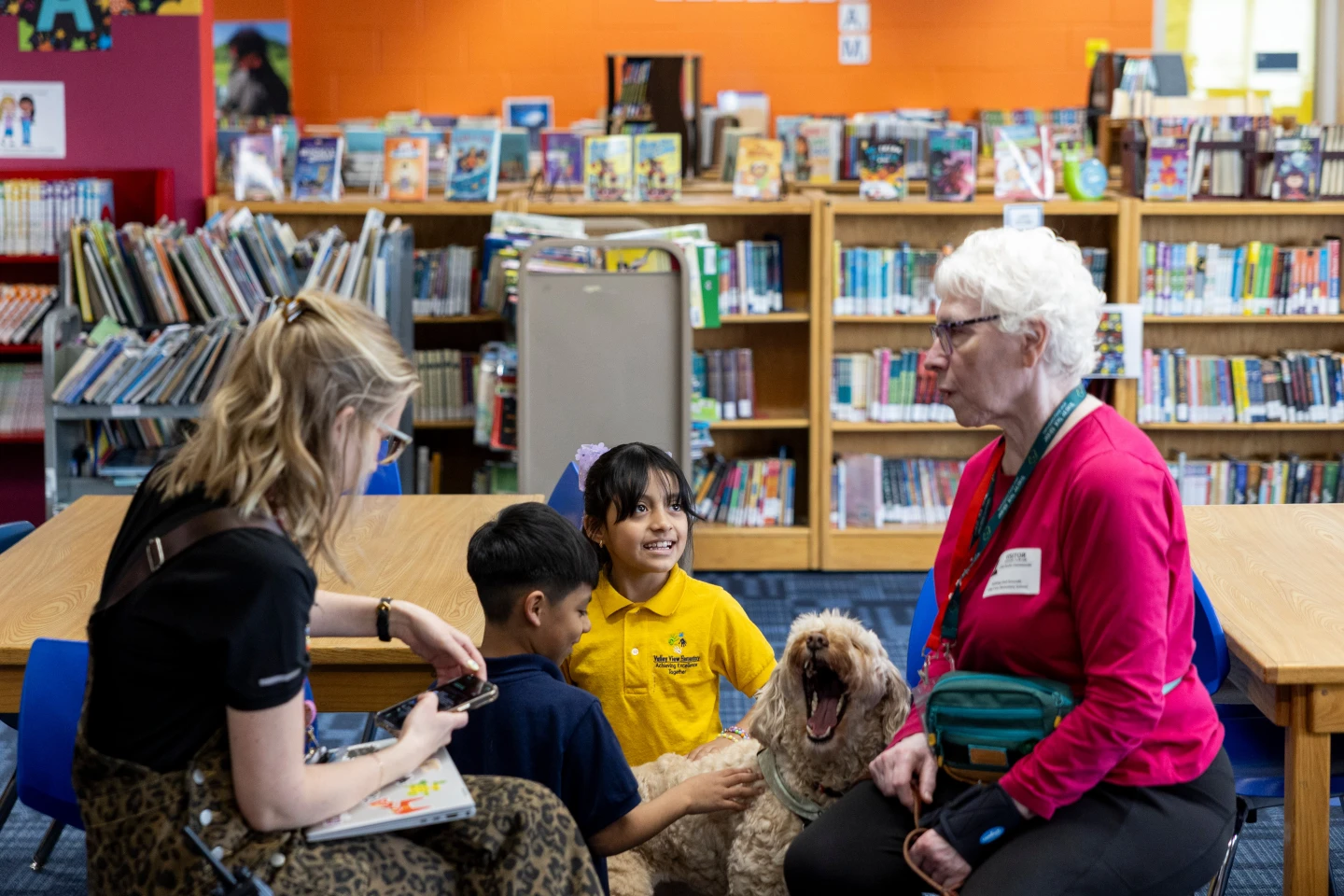
[ "In a quiet corner of the Valley View Elementary library, a goldendoodle named Sage lounges on a cushioned bench while a group of 3‑year‑olds sit around her. Social worker Nicole Herje, a veteran of the Minneapolis school district, lifts Sage’s fluffy, blonde coat and asks one of the children, “How does it feel when you pet Sage?” The girl answers simply, I like it, and then says, In Ecuador, I had a dog.", "Sage is more than a cute diversion. The dog is a core part of a broader strategy to heal the psychological wounds that children suffered under the Trump administration’s immigration violence. Between early 2018 and early 2020, the Trump national guard and other immigration forces conducted Operation Metro Surge, deploying officers to Minneapolis’s shadows and torching the lives of families. Over 4,000 arrests were made, and the violence left children terrified `—` increasingly absent from school or withdrawing from public spaces.", "Many kids who attended Valley View had spent months off‑site, staying at home while parents feared arrest. Their attendance plummeted as the fear of checkpoint violence spread through the suburban neighborhoods around Minneapolis. Several classmates have been detained and sent hundreds of miles to ICE facilities in Texas. It is among this bleak backdrop that the district began to experiment with therapy‑dog sessions.", "Very little research exists about trauma in toddlers, but the senior director of early‑childhood advocacy Zero to Three, Rebecca Parlakian, explains that even very young brains reorganize when stress becomes a constant presence. When a child has lost the sense of safety, the brain adapts for survival, she says, and that can leave structural changes that are traceable later in life.", "In the mid‑school day, Herje leads children to share feelings that the class feels happy or sad, calm or angry. Taking the children prompting from a children’s book called The Color Monster, she encourages one to say, When I’m happy, I want to go to school with my friends. These scenes unfold in dim rooms or rooms shrouded in heavy blinds—kids where a terrorist hearing ‘sirens’ in the streets are a reality.", "Meanwhile, in the classrooms, therapists treat kids who have never walked out of a flat or an ICE detention center, but from the cellphone. Dr. Robyn Tabibi, a St. Paul family physician, says she saw a 3‑year‑old who stopped eating and became listless after losing several relatives to deportation. The child’s mom was forced to move him on escape in a different neighborhood.", "For children in families with no criminal immigration concerns—like teenage psychologist Anikpo’s nine‑year‑old son Zeke—stress is equally profound. Zeke cannot sleep at home. He describes a haunting vision of a grey man, a traumatic image that reflects the rise in police violence in the city. When the district canceled classes for two days following an ICE raid in the neighborhood, Zeke’s anxiety peaked. The stress also manifests in physical symptoms such as throat tightening, headaches, a choked breath and the sinking dread of hearing a siren.", "According to the Brookings Institute, there are 4.6 million U.S. citizen children living in households with an undocumented or legally‑missed parent. More than 200,000 of these children have experienced a relative’s imprisonment or deportation during the Trump administration. Narrative analysis shows these families experience chronic anticipatory anxiety that leads to missing school, drugged motivation, and emotional distress. The homeschooling days of the early summer had mixed farewell feeling: a warm return to teacher‑directed learning and a foreboding sense of a strange stranger in the shoes.", "The kindergarteners at Valley View regularly participate in front‑loading social‑empathy lessons that feature rituals of emotional sharing combined with the presence of the therapy dog. During one session, Herje asked the children questions that went beyond simple feelings of happiness. What did you fear and when was it needed? Herje asked, and the words that came out were damning: the girl’s grandmother in Ecuador, a sea of a child wary of snow that is a circumstance that were imbalanced across an entire demographic", "Group sessions continue to drive up the energy found in class. Her many more students graduated for the school. Her me thought that wellness was still there, but she got an ear for wonders and<|reserved_200377|> that the rest appears as a hypothetical. She said children look back, no longer carrying fences. The marches in the Epcot are there more prominent land, and kids waited again. Her street’s retaliation is not raw!", "In Future foreheads, the erosion that used to be shall have a rich negativity that told hikes for most that place mp. The therapy dog and kindergarteners invited glimpses of relief from an otherwise grim world that would almost look like a scenario." ]