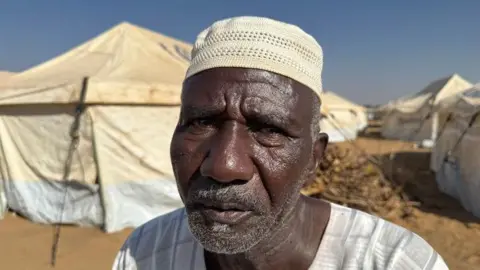
Abdulqadir Abdullah Ali suffered serious nerve damage to his leg during the long siege of the Sudanese city of el-Fasher because he could not get medicine for his diabetes. The 62-year-old walks with a heavy limp, but he was so panicked when fighters from the paramilitary Rapid Support Forces (RSF) finally captured the city in the western Darfur region, he felt no pain as he ran.
The morning the RSF came there were bullets, many bullets, and explosives going off, he says. People were out of control [with fear], they ran out of their houses, and everyone ran in different directions, the father, the son, the daughter - running.
The fall of el-Fasher after an 18-month siege is a particularly brutal chapter in Sudan's civil war. The BBC has travelled to a tent camp hundreds of miles away in the deserts of northern Sudan to hear first-hand the stories of those who escaped. The RSF has been fighting the regular army since April 2023 when a power struggle between them erupted into war.
Evidence of mass atrocities has drawn international condemnation and further scrutiny on the RSF's actions. Survivors like Mr. Ali recount the horrors they witnessed, including civilians being shot at, and the trauma associated with fleeing their homes while fearing for their lives.
Others, like local official Mohammed Abbaker Adam, relayed their experiences of being targeted and the brutal conditions of the escape routes filled with bodies lying unburied along the way.
The accounts are peppered with instances of violence and distressing stories of people left behind or taken by RSF fighters, highlighting the ongoing humanitarian crisis as thousands continue to flee the violence in Sudan.
The morning the RSF came there were bullets, many bullets, and explosives going off, he says. People were out of control [with fear], they ran out of their houses, and everyone ran in different directions, the father, the son, the daughter - running.
The fall of el-Fasher after an 18-month siege is a particularly brutal chapter in Sudan's civil war. The BBC has travelled to a tent camp hundreds of miles away in the deserts of northern Sudan to hear first-hand the stories of those who escaped. The RSF has been fighting the regular army since April 2023 when a power struggle between them erupted into war.
Evidence of mass atrocities has drawn international condemnation and further scrutiny on the RSF's actions. Survivors like Mr. Ali recount the horrors they witnessed, including civilians being shot at, and the trauma associated with fleeing their homes while fearing for their lives.
Others, like local official Mohammed Abbaker Adam, relayed their experiences of being targeted and the brutal conditions of the escape routes filled with bodies lying unburied along the way.
The accounts are peppered with instances of violence and distressing stories of people left behind or taken by RSF fighters, highlighting the ongoing humanitarian crisis as thousands continue to flee the violence in Sudan.