In brief
Ukraine faced a significant setback as overnight Russian strikes targeted key energy and industrial sites, causing over one million households to lose power. Internal affairs minister Ihor Klymenko reported multiple regions affected, ongoing rescue efforts, and the presence of injuries. The recent escalation coincides with diplomatic discussions among international leaders, including US envoy efforts to mediate a peace agreement. Russia's military claims it utilized advanced weaponry, including hypersonic missiles, during attacks that also compromised the Zaporizhzhia nuclear power plant’s backup power supply.
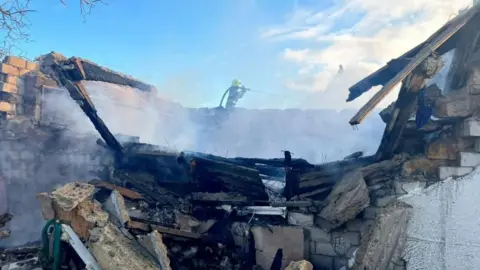
More than a million households are without electricity in Ukraine after a barrage of overnight Russian strikes hit energy and industrial infrastructure, officials said.
Ukraine's internal affairs minister, Ihor Klymenko, said five regions were hit and at least five people were injured, and work was under way to extinguish fires and restore supplies.
While Russian attacks on Ukrainian energy infrastructure have been common throughout the war, Moscow has intensified strikes as the country heads into winter.
It comes as US President Donald Trump's overseas envoy will travel to Germany this weekend to meet Ukrainian President Volodymyr Zelensky and European leaders for more talks on ending the war.
Steve Witkoff, who has been leading White House attempts to mediate between Ukraine and Russia, will discuss the latest version of the proposed peace agreement in Berlin.
On Saturday, Zelensky said more than 450 drones and 30 missiles were used by Russia in the overnight strikes. Klymenko said the Dnipropetrovsk, Kirovohrad, Mykolaiv, Odesa, and Chernihiv regions were hit.
Russia's defense ministry said it used weapons including Kinzhal hypersonic missiles in the strikes - which are hard to track as they can change direction mid-flight.
The International Atomic Energy Agency (IAEA) said Ukraine's Zaporizhzhia nuclear power plant temporarily lost all offsite power overnight 'due to widespread military activities affecting the electrical grid', but is now reconnected.
In Russia, regional governor Roman Busargin said two people were killed in Saratov after a drone strike hit a residential building.
The Trump administration is pushing for a deal to end the war to be in place by Christmas and has held several rounds of talks with Ukrainian and Russian representatives in recent weeks, though there has been little sign a breakthrough is imminent.
It has not yet been confirmed which European leaders will attend the Berlin talks.
The Wall Street Journal, which first reported details of the meeting, said UK Prime Minister Sir Keir Starmer, French President Emmanuel Macron and German Chancellor Friedrich Merz would all take part.
The Witkoff-Zelensky meeting comes after Ukraine gave the US its revised version of a 20-point peace plan, the latest iteration of a proposal which first emerged in late November and has triggered a flurry of diplomatic activity.
The fate of territory in eastern Ukraine remains one of the most intractable topics in the negotiations, with Kyiv refusing to cede land which has been illegally occupied, and Moscow repeating its intention to take the Donbas region in full by force unless Ukraine withdraws.
Zelensky has reacted skeptically to the White House's latest proposal on resolving the territorial question, which is for Ukraine's army to pull out of the region and for it to be turned into a 'special economic zone'.
The Ukrainian president told reporters that under the US-proposed terms, the Kremlin would undertake not to advance into the areas vacated by Ukraine's forces, with the land between Russian-controlled parts of the Donbas and Ukraine's defensive lines effectively turned into a demilitarized zone.
As the White House's diplomatic push continues, attention in Europe is focused on how to support Ukraine in the event of a peace deal, with talks ongoing over security guarantees and funding.
The Ukrainian government faces a stark financial situation: it needs to find an extra €135.7bn (£119bn; $159bn) over the next two years.
On Friday, EU nations agreed to indefinitely freeze around €210bn (£185bn; $247) worth of Russian assets held in Europe.