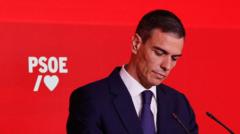
Prime Minister Pedro Sánchez of Spain extended his apologies to the nation following a burgeoning corruption scandal that led to the resignation of Santos Cerdán, a prominent member of the Socialist Party. Addressing the public, Sánchez acknowledged the reality of political corruption and emphasized the importance of "zero tolerance" for such actions, while striving to disassociate himself from the scandal by ruling out early elections.
Cerdán, who has come under scrutiny regarding potential misconduct involving public contracts and kickbacks, will appear in court in June to defend himself against these allegations. His unexpected resignation has triggered a wave of dissent, with conservative leader Alberto Núñez Feijóo urging Sánchez to step down, stating, "Survival is no longer an option."
Sánchez expressed disappointment over his misplaced trust in Cerdán and launched a campaign to reinforce the leadership of his Socialist PSOE party. "This is not about me, and it's not about the Socialist party," Sánchez asserted, indicating his commitment to continuing his political agenda while reaffirming his intent to maintain coalition stability until 2027.
The opposition's outcry has intensified, especially following a significant rally in Madrid where tens of thousands called for Sánchez's resignation under the slogan "mafia or democracy." Feijóo has called upon other coalition members to abandon Sánchez, stressing that corruption has become synonymous with the current administration.
As speculation mounts regarding his political future, Sánchez reaffirmed during a press conference that he had no prior knowledge of the activities linked to Cerdán and rejected the notion that the scandal was indicative of his party's dysfunction. Citing previous political challenges and revealing his determination to pursue "clean politics and democratic renewal," Sánchez remained defiant against criticism from opposition parties.
The gravity of the situation has escalated with allegations against Cerdán involving substantial sums linked to kickback schemes, as detailed in police reports based on recordings amassed over four years. With former officials, including ex-Transport Minister José Luis Ábalos, also implicated, the unfolding case represents a serious concern for Sánchez, despite his insistence on remaining unaffected by the scandal personally.
With tensions rising, Sánchez continues to navigate the turbulent political landscape, facing questions about integrity and accountability as he seeks to reassure the Spanish public about the future of his government amidst increasing unrest.