In brief
In the heart of Gaza City, amid the remnants of war, Baraa Abu al-Aoun dedicates his days to meticulously repairing damaged banknotes to keep cash flow alive in a besieged economy. The ongoing cash crisis, triggered by the destructive conflict, sees many residents turning to informal services as banks remain largely non-functional. The article explores the challenges faced by Gazans and how people like Baraa have adapted to keep their communities functioning.
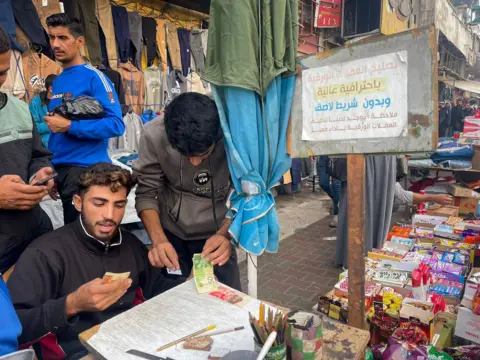
In a bustling Gaza City market, a money repairer expertly inspects a worn, yellow 100 shekel ($30.50; £23.10) note. He straightens it out and enhances its faded colour with careful strokes of a pencil.
Baraa Abu al-Aoun should have been studying at university - but instead he ekes out a living from a table he has set up at the roadside, taking a small sum to help keep cash in circulation.
Fixing banknotes is a thriving new business in Gaza.
Ever since the deadly Hamas-led attack on Israel in 2023 and the devastating war that ensued, Israel stopped transfers of banknotes, along with most other supplies.
Most banks were destroyed in Israeli strikes, and many were looted. While some branches have reopened since a ceasefire took effect seven weeks ago, there are still no working ATMs.
But people need cash to buy food and essentials. That has forced them to turn to informal money merchants who charge enormous commissions to turn digital transfers into cash. It has also sparked a huge increase in the use of e-wallets and money transfer apps.
And it means that every existing banknote matters more than ever - no matter how tattered. That's where Baraa comes in. My tools are simple: a ruler, pencils, coloured pencils and glue, he says.
The ceasefire hasn't changed the financial situation. What I do now is to serve people and help them.
Gaza's economic collapse has been so catastrophic during two years of intense war that a new UN report says its entire population of more than two million has been pushed into poverty.
Four in five people are now unemployed according to the UN Conference on Trade and Development (Unctad), and even those who still have an income or savings struggle to access cash.
Early in the war, Israeli strikes targeted banks, which Israeli officials alleged were linked to Hamas. Their vaults were looted by armed Palestinian gangs, some presumed to have been Hamas. The Palestine Monetary Authority (PMA) has previously said that cash worth about $180m (£136m) was stolen.
Cogat, the Israeli defence body which controls Gaza's border crossings, confirmed that in line with a political order and due to Hamas's reliance on cash to maintain its military activity, Israel has not been allowing cash to enter Gaza.
The lack of cash circulating has caused problems for both sellers and buyers, says Zakaria Ajour, a stall-holder at another market in Gaza City. People don't want to accept worn and delicate notes at face value anymore, if there are even small scratches or pieces of tape on a note.
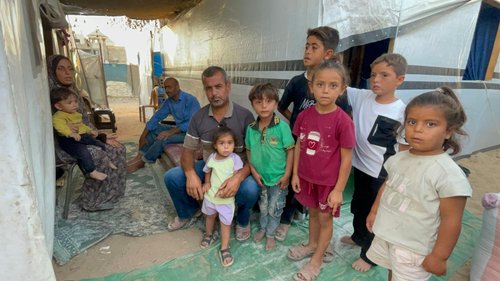
Asmaa al-Ladaa wants to set up an account so that she can receive money directly from her relatives living outside Gaza. The whole process is just chaos and crowds, she says. We woke up at 06:00 and left our children behind in a tent. We left everything just to come to the bank.
Back in Gaza City, Baraa Abu al-Aoun holds the banknote he has been working on up to the light, expertly repairing it. He has more customers waiting, attracted by his sign promising repairs with high professionalism and without adhesive tape. As Baraa toils on, he longs for a return to a normal life with prospects of more profitable employment.
I just want this war to end fully, he says. My hope is to feel relief at last, so that I can study and work with a degree. In Gaza, we're just surviving. We're not human beings anymore.