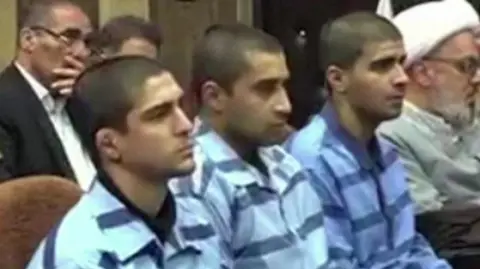
Iran has executed three men accused of killing police officers during anti-government protests in January, marking the first hangings to be carried out in relation to the demonstrations.
Among the executed was teenager Saleh Mohammadi, a member of Iran's national wrestling team.
The executions occurred in the northern Qom province after the Supreme Court upheld their death sentences, according to reports from Iran's state-run Tasnim news agency.
The nationwide protests, which began in December 2022 and escalated in January 2023, were met with a violent crackdown from authorities, leading to thousands of deaths, as reported by various rights groups.
According to Tasnim, Mohammadi, along with his accomplices Mehdi Ghasemi and Saeed Davoudi, were found guilty of killing two police officers in separate incidents during the protests.
They also faced charges of moharebeh—waging war against God—a term often used in Iran to justify death sentences against protesters and dissidents.
Human rights advocates argue that the three men were coerced into confessing under torture and did not receive fair trials.
These executions followed the death of Kouroush Keyvani, a dual Iranian-Swedish national, who was hanged after being convicted of espionage—a sentence criticized by foreign officials, including Sweden's foreign minister, for lacking legal security.
The protests erupted in response to economic turmoil, particularly rising living costs and the collapse of the Iranian currency, quickly evolving into demands for political reform, posing a significant challenge to the clerical establishment since the 1979 Islamic revolution.
With reports of massive casualties—including at least 6,488 protesters and 236 children—the situation remains dire, as security forces' responses to protests continue to escalate. The crackdown, labeled as one of the most violent in Iran's recent history, has left many communities reeling from the loss.
}