In brief
In the wake of war, Iran's leadership appears fragmented despite the formal authority of Mojtaba Khamenei, the new supreme leader. His lack of public presence and the role of other political actors raise questions about who truly makes decisions in Tehran. Understanding the dynamics of uncertainty and the shifting power within Iran's government is critical as the country navigates this tumultuous period.
The question hanging over Tehran since the opening strikes of Iran's current war with the US and Israel is simple: Who is in charge?
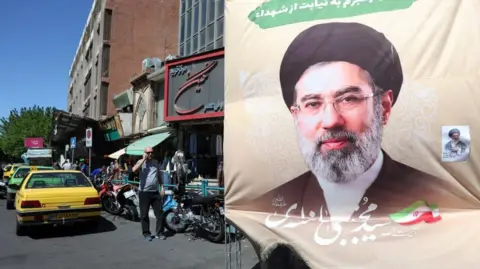
Formally, the answer is clear. Mojtaba Khamenei has assumed the role of supreme leader following the killing of his father, Ali Khamenei, on the first day of the war on 28 February. In the Islamic Republic's system, that position is meant to be decisive. The leader has the final word on almost anything important: war, peace, and the state's strategic direction.
But in practice, the picture is far murkier. Donald Trump has described Iran's leadership as fractured and suggested the US is waiting for Tehran to produce a unified proposal. Unity was certainly on the minds of Iran's leaders when they distributed a message to Iranians stating that there was no such thing as a hardliner or moderate in Iran - there was just one nation, one course.
Invisible Leader
Mojtaba Khamenei has not been seen in public since taking power. Beyond a handful of written statements, there is little direct evidence of his day-to-day control. Iranian officials have acknowledged that he was injured in the initial strikes but have offered few details. Reports indicate he sustained injuries that have made it difficult for him to speak, raising concerns over his ability to manage the country's affairs effectively.
The result is a vacuum of interpretation. Some assert that Mojtaba's elevation has simply not allowed him to establish authority on his own terms, while others question whether he is able to manage the political landscape at all during this turbulent time.
Decision-making appears less centralized than it was before the war. Diplomacy operates nominally under Foreign Minister Abbas Araghchi, but his authority is undermined by the fact that Iran's delegation is led by Parliament Speaker Mohammad-Bagher Ghalibaf.
A Military Expanding Remit
Meanwhile, the Islamic Revolutionary Guard Corps (IRGC) has gained significant influence, particularly over military decisions, resting key powers in the hands of actors who operate behind the scenes. The IRGC's actions are increasingly dictating the pace of the crisis, raising issues surrounding the coherence and directedness of Iran's leadership.
Amidst this ambiguity, Ghalibaf, who has been active in negotiations and public statements, has emerged as a visible figure, though his position remains precarious against a backdrop of hardline resistance to negotiations.
Claimed or Exercised Coherence
Taken together, these dynamics suggest a system functioning without a coherent direction. The supreme leader's authority exists but is not visibly exercised; diplomacy is active but not decisive. The military holds key levers without a clear public architect, indicating a struggle to maintain coherence under pressure.
As Iran continues to navigate these challenges, the question looms: is the semblance of coherence being exercised or merely claimed? The Islamic Republic remains intact, but how it channels its power and strategy moving forward is increasingly uncertain.