In brief
For a country still in the throes of a three‑decade conflict, a brutal rise in civilian violence is centring the political debate. Armed groups such as FARC dissidents, the ELN and the Clan del Golfo have doubled their numbers in recent years and seized rural territories, boosting drug‑trafficking and illegal mining. Two candidates grapple over how best to tackle this crisis: left‑wing senator Iván Cepeda advocates negotiated strategies that combine state repression with social programmes, while right‑wing businessman Abelardo de la Espriella pushes for hard‑line military action and mega‑prisons. How the election outcome will reshape Colombia’s security and social landscape remains the story voters will decide.
For a country still in the throes of a three‑decade armed struggle, a surge in civilian violence is now the central theme of the upcoming presidential election.
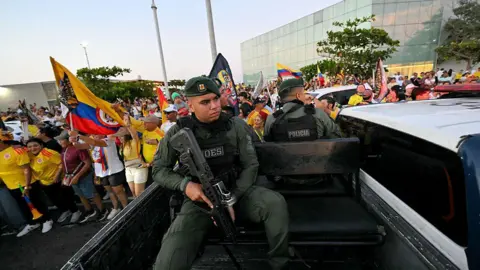
Illegal militias – the FARC dissidents, the National Liberation Army (ELN) and the Clan del Golfo – have roughly doubled in membership over the past five years. They hold sway over rural districts that are key to cocaine trafficking and illegal mining, leaving a void that the army cannot fill.
Forced displacement has risen 300% between 2024 and 2025, according to government advisor Isabelita Mercado Pineda. She says the “failure” of the state’s policy gives criminals a carrot but not enough stick.
Voters see security as the decisive issue of the election. Two candidates embody divergent visions.
Left‑wing senator Iván Cepeda, architect of President Gustavo Petro’s “total peace” strategy, stresses negotiated peace with armed groups, arguing that such dialogue has prevented a larger loss of life. He also pushed the 2016 peace deal that demobilised thousands of FARC fighters.
Opposite him stands right‑wing businessman Abelardo de la Espriella, endorsed by Donald Trump. He pledges ten mega‑prisons, a hard‑line military crackdown and an end to any negotiations with the gangs. He calls himself “El Tigre” and claims the United States will fully back him if elected.
De la Espriella’s promises resonate in his home region on the Caribbean coast, where he enjoys strong support. He says he will work with the U.S. to fight drug trafficking and that he will not compromise with criminals.
Meanwhile, Cepeda appeals to younger voters who wish for a “negotiated security” model that blends repression and social programmes to tackle the lack of state presence, poverty and inequality.
In the run‑off election this Sunday, Colombian voters will decide between a hard‑line stance and a negotiated approach to the crisis that has cost hundreds of thousands of lives.