Just over two years ago, when Sheikh Hasina won an election widely condemned as rigged in her favour, it was hard to imagine her 15-year grip on power being broken so suddenly, or that a rival party that had been virtually written off would make such a resounding comeback. But in the cycle of Bangladeshi politics, this is one more flip-flop between Hasina's Awami League and the Bangladesh Nationalist Party (BNP), which have alternated holding power for decades.
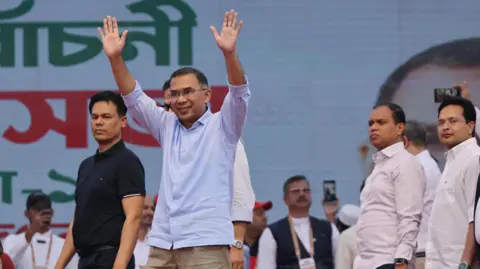
Except this is the first time that new BNP leader Tarique Rahman is formally leading the party - and the first time he's contested an election. His mother Khaleda Zia, who died of an illness late last year, was the party's head for four decades. She took over after his father, Ziaur Rahman, the BNP founder and a key leader of Bangladesh's war for independence, was assassinated.
Accused of benefitting from nepotism when his mother was in power, Tarique Rahman has also faced allegations of corruption. Five days before his mother died, he returned to Bangladesh after 17 years of self-imposed exile in London. And while Rahman, 60, has on occasion been the de-facto chair of an emaciated BNP when his mother was jailed and more recently when she was ill, he's largely seen as an untested leader.
That he doesn't have prior experience probably works for him, because people are willing to give change a chance, says political scientist Navine Murshid. They want to think that new, good things are actually possible. So there is a lot of hope.
The BNP's first priority is said to be restoring democracy in Bangladesh. Their promises echo previous declarations, creating a sense of skepticism based on historical patterns of power consolidation by past leaders once in office. However, with a young and engaged populace, especially those involved in the 2024 uprising that led to Hasina's ousting, there is a renewed demand for accountability and transparency.
We don't want to fight again, says Tazin Ahmed, a 19-year-old who participated in the uprising, highlighting the sentiment among the youth. They demand a stable economy devoid of corruption as a true victory, signifying a shift in political consciousness among voters.
Facing the challenges of governance amidst a backdrop of violence and unrest, the new administration led by Rahman has a substantial task ahead: ensuring law and order, economic revitalization, and job creation for the youth. The task ahead seems formidable not only for Rahman, who lacks previous political experience as a leader, but also for the established seasoned politicians who have yet to grasp the pressing needs of the contemporary populace.
As Bangladesh embarks on this new chapter, the political future remains uncertain, underscored by the interplay between hope for change and the haunting specter of previous political betrayals.
Except this is the first time that new BNP leader Tarique Rahman is formally leading the party - and the first time he's contested an election. His mother Khaleda Zia, who died of an illness late last year, was the party's head for four decades. She took over after his father, Ziaur Rahman, the BNP founder and a key leader of Bangladesh's war for independence, was assassinated.
Accused of benefitting from nepotism when his mother was in power, Tarique Rahman has also faced allegations of corruption. Five days before his mother died, he returned to Bangladesh after 17 years of self-imposed exile in London. And while Rahman, 60, has on occasion been the de-facto chair of an emaciated BNP when his mother was jailed and more recently when she was ill, he's largely seen as an untested leader.
That he doesn't have prior experience probably works for him, because people are willing to give change a chance, says political scientist Navine Murshid. They want to think that new, good things are actually possible. So there is a lot of hope.
The BNP's first priority is said to be restoring democracy in Bangladesh. Their promises echo previous declarations, creating a sense of skepticism based on historical patterns of power consolidation by past leaders once in office. However, with a young and engaged populace, especially those involved in the 2024 uprising that led to Hasina's ousting, there is a renewed demand for accountability and transparency.
We don't want to fight again, says Tazin Ahmed, a 19-year-old who participated in the uprising, highlighting the sentiment among the youth. They demand a stable economy devoid of corruption as a true victory, signifying a shift in political consciousness among voters.
Facing the challenges of governance amidst a backdrop of violence and unrest, the new administration led by Rahman has a substantial task ahead: ensuring law and order, economic revitalization, and job creation for the youth. The task ahead seems formidable not only for Rahman, who lacks previous political experience as a leader, but also for the established seasoned politicians who have yet to grasp the pressing needs of the contemporary populace.
As Bangladesh embarks on this new chapter, the political future remains uncertain, underscored by the interplay between hope for change and the haunting specter of previous political betrayals.