In brief
Greenlanders express deep concerns over US interventionist strategies aimed at the island. With US Secretary of State Marco Rubio planning discussions with Danish and Greenlandic officials, local residents echo a desire for autonomy and peace, fearing a loss of their sovereignty.
US Secretary of State Marco Rubio will meet Danish and Greenlandic officials next week to discuss the fate of Greenland - a semi-autonomous territory of Denmark that President Donald Trump says he needs for national security.
The vast island finds itself in the eye of a geopolitical storm with Trump's name on it and people here are clearly unnerved.
Yet when you fly in, it looks so peaceful. Ice and snow-capped mountains stretch as far as the eye can see, interrupted here and there by glittering fjords - all between the Arctic and the Atlantic Oceans.
It is said to sit on top of the world; much of it above the Arctic Circle.
Greenland is nine times the size of the UK but it only has 57,000 inhabitants, most of them indigenous Inuit.
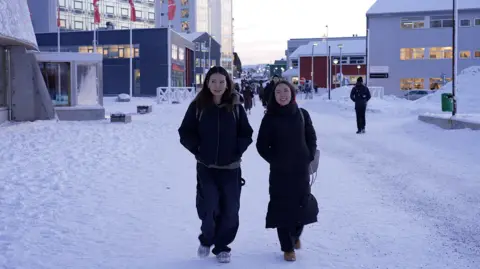
You find the biggest cluster of Greenlanders on the south-western coast in the capital, Nuuk. We arrived there as a frozen twilight was creeping across snow-covered pedestrian streets.
Parents dragged their children home from school on sledges, and students mooched their way in and out of brightly-lit malls. Few wanted to talk to us about the Trump-related angst here. Those who did sounded very gloomy.
One pensioner banged his walking stick on the ground in emphasis as he told me the US must never plant its flag in Greenland's capital.
A lady who said she was mistrustful of everyone these days, and didn't give her name, admitted she was scared to death about the prospect of Trump taking the island by force after she watched his military intervention in Venezuela.
Meanwhile, 20-something pottery-maker Pilu Chemnitz said: I think we are all very tired of the US president. We have always lived a quiet and peaceful life here. Of course, the colonisation by Denmark caused a lot of trauma for many people but we just want to be left alone.
Never mind opposing a takeover by the US, which 85% of Greenlanders say they do, most also say they favour independence from Denmark - although many tell me they appreciate the Danish subsidies that help prop up their welfare state. While rich in untapped natural resources, poverty is a real issue here in Inuit communities.
Overall, Greenlanders want a bigger, louder say, not only in their domestic policies, but in foreign affairs too.
I went to the island's modest-looking parliament, the body of it built in a Scandinavian style with wooden slats and painted the same burnished red as the Greenlandic flags fluttering by the entrance.
No security checks. All pretty relaxed. Except for the roaring polar bear emblem - a symbol of Greenland, etched onto every sliding glass doors we pass.
I was there to meet Pipaluk Lynge-Rasmussen, co-chair of the foreign affairs committee in parliament. She is an MP with the pro-independence Inuit Ataqatigiit party that is part of the coalition government here.
I think it's very important for us to speak out about what we want as a people, she told me. We have always worked towards independence when we got home rule in 1979 and more independence in 2009.
Despite the ongoing geopolitical pressures, Greenlanders express a strong desire for autonomy and a peaceful existence, hoping their voices will be heard in discussions that impact their future.