In brief
Evidence from a BBC investigation indicates that the Georgian police employed an outdated World War One chemical weapon against protesters, leading to serious health complications. Victims reported sensations of burning, coughing, and vomiting after exposure. Experts have confirmed that the chemical, believed to be 'camite', poses significant dangers and its use may contravene international law on the use of riot control agents. Authorities have dismissed these claims as absurd, amidst ongoing protests regarding political shifts within the country.
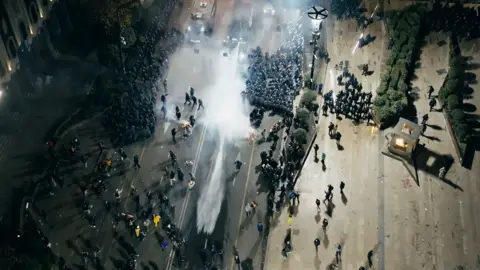
Georgia's authorities used a World War One-era chemical weapon to quell anti-government protesters last year, evidence gathered by the BBC suggests. You could feel [the water] burning, one of the protesters said of water cannon turned on him and others on the streets of the capital Tbilisi. A sensation, he said, which could not immediately be washed off. Demonstrators against the Georgian government's suspension of its European Union accession bid have complained of other symptoms too - shortness of breath, coughing, and vomiting that lasted for weeks.The BBC World Service has spoken to chemical weapons experts, whistleblowers from Georgia's riot police, and doctors, and found the evidence points to the use of an agent that the French military named camite. The Georgian authorities said our investigation findings were absurd and the police had acted legally in response to the illegal actions of brutal criminals. Camite was deployed by France against Germany during World War One. There is little documentation of its subsequent use, but it is believed to have been taken out of circulation at some point in the 1930s, because of concerns about its long-lasting effects. CS gas - often referred to as tear gas - was used as a replacement.Konstantine Chakhunashvili was one of those who gathered outside Georgia's parliament in Tbilisi during the first week of protests - which began on 28 November 2024. Demonstrators were incensed by the ruling party's announcement that it was pausing EU accession talks. The goal of EU membership is enshrined in Georgia's constitution.Georgia's police responded with a variety of riot-control measures including the use of water cannon, pepper spray and CS gas. Dr Chakhunashvili, a paediatrician, noted his skin felt like it was burning for days. He appealed via social media for those also targeted during the protests to fill out a survey. Nearly 350 reported long-term side-effects ranging from headaches to significant heart abnormalities.Lasha Shergelashvili, a former head of weaponry at the Special Tasks Department, confirmed similar experiences following chemical tests conducted years earlier. Whistleblower accounts suggest that the same harmful chemical was used during the protests of November-December 2024.Experts have raised alarms that using an antiquated and stronger chemical in place of established agents may classify it as a chemical weapon. Under international law, police forces are allowed to use chemicals as crowd-control agents, provided the effects are proportionate and temporary. However, concerns exist that the utilization of camite might be a violation of human rights laws. The protests have continued, with increasing calls for the resignation of the government amidst claims of election rigging and alignment with Russian interests.