In brief
The Polish candidate's unconventional marketing strategy has sparked social media ridicule and raised questions about his credibility as he approaches the presidential election.
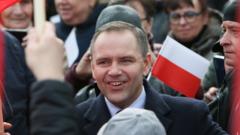
In an unexpected twist of political drama, Polish presidential candidate Karol Nawrocki has found himself at the center of ridicule after revelations surfaced regarding his past promotional strategies. It has come to light that Nawrocki, associated with the right-wing Law and Justice party (PiS), once donned a disguise to extoll the virtues of his own book, which he authored under the pseudonym Tadeusz Batyr. The book chronicles the life of a gangster during the tumultuous period of 1980s communist Poland, and Nawrocki's decision to appear on television dressed as Batyr—complete with a hat and obscured face—has incited a wave of mockery on Polish social media. During the appearance, a blurred figure praising the historian claimed, "This historian [Karol Nawrocki] inspired me…" adding an awkward acknowledgment that Nawrocki was the first person to study organized crime in the communist era. Further compounding the embarrassment, Nawrocki's past social media interactions revealed that he had previously claimed to have met Batyr, stating, "I spent several years studying organized crime… so Tadeusz Batyr contacted me for some guidance." As the backlash grew, Nawrocki attempted to downplay the incident, asserting, "Literary pseudonyms are nothing new in Polish academia," while simultaneously highlighting his own historical contributions.Amid this controversy, Nawrocki trails behind Warsaw Mayor Rafal Trzaskowski in the race for the presidency. Trzaskowski, a member of Prime Minister Donald Tusk's liberal Civic Coalition party, is currently polling favorably, whereas far-right candidate Slawomir Mentzen has begun gaining traction with his ultra-low tax promises and stances against immigration.The implications of the presidential race extend well beyond domestic issues. Poland plays a crucial role in supporting Ukraine, and a new administration could either bolster or hinder foreign policy strategies amid the ongoing conflict with Russia. Nawrocki has openly criticized "European elites" for their role in the war, while his party aims to provide energy security and lower taxes. Political analyst Marcin Zaborowski remarked on the significance of the election, highlighting that any presidency supporting Tusk's reform agenda could lead to substantial legislative changes for the Polish public. As the first round of voting approaches in less than two months, Nawrocki has been actively campaigning, striving to solidify his position against the shadows of his own questionable past.