In brief
This fascinating research highlights the significance of scents in ancient mummification practices and offers insights into museum conservation efforts.
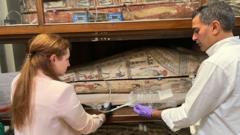
In an intriguing find, scientists have revealed that ancient Egyptian mummies, even after resting in their sarcophagi for over 5,000 years, exude a surprisingly pleasant aroma. A team of researchers analyzed nine mummies and discovered that their scents varied in intensity but could generally be described as "woody," "spicy," and "sweet." The goal of this study was not only to document these aromas but also to reconstruct their scents for exhibition at the Egyptian Museum in Cairo, allowing visitors to experience a whiff of ancient history.Cecilia Bembibre, one of the lead researchers, explained the pivotal role of scents during the mummification process. Ancient Egyptians adorned mummies with fragrant oils and balms, believing that these pleasant fragrances would aid the spirit in its journey to the afterlife. "In various portrayals, we often associate mummies with disturbing scents," Dr. Bembibre noted, emphasizing the surprising nature of their findings. The innovative study, recently published in the Journal of the American Chemical Society, employed a technique involving a tiny tube to capture scents from inside the sarcophagus without directly sampling the mummy. The researchers were focused on preserving the integrity of these ancient artifacts while uncovering new knowledge. The goal is to share this unique sensory experience, inviting museum-goers to interact with history in an unprecedented way.Ally Louks, an English literature supervisor who specializes in the cultural significance of smell, described this project as a "truly innovative" method for conveying historical narratives. According to Dr. Louks, scents played a crucial role in ancient Egyptian social, religious, and personal practices. The results of the study also hold implications for understanding the social status of mummies based on their accompanying aromas.Furthermore, the research has promising ramifications for the preservation of mummies. Using gas chromatography, scientists analyzed the mummification scents, detecting breakdown indicators in animal fats used during the embalming process. This information could prove invaluable for conservators working to protect these historically significant remains.Overall, the findings shed light on the sensory experience of ancient Egypt and offer a groundbreaking approach to enhancing the study and conservation of mummified remains. Dr. Bembibre emphasized that their discoveries will enable conservators to make informed decisions about how to ensure these precious artifacts are preserved for future generations.