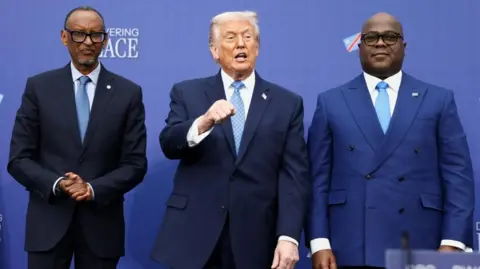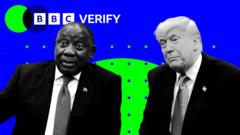
In a meeting at the White House, Donald Trump and South African President Cyril Ramaphosa engaged in a confrontational discussion that revolved around controversial claims concerning the safety of white farmers in South Africa. What started as a friendly exchange quickly escalated as Trump presented various pieces of evidence, including video clips and articles that he argued illustrated widespread violence against white farmers.
One prominent moment during the meeting was when Trump requested his staff to show a video of South African politicians purportedly inciting violence against white farmers. He aired footage suggesting that rows of white crosses represented graves of murdered farmers, claiming "these are burial sites" for over a thousand white farmers. However, this assertion has been fact-checked and found to be misleading; the crosses were actually erected as a temporary memorial for Glen and Vida Rafferty, a farming couple murdered in 2020. Rob Hoatson, an organizer of the memorial event, clarified that the crosses marked the site as a remembrance, not an actual burial ground, as confirmed by recent footage showing the crosses had been removed.
Further scrutinizing Trump's claims, the assertion of a genocide against white farmers was challenged. During the meeting, Trump suggested that many felt persecuted, linking their alleged plight to a broader narrative of "white genocide." This claim, however, lacks solid evidential support; with police statistics indicating only a small number of farmers killed compared to overall murder rates in South Africa. In fact, only 44 members of the agricultural community were killed last year, casting doubt on the widespread allegations that Trump and his supporters have long propagated.
Additionally, Trump showcased video footage featuring controversial political rallies where participants sang "Kill the Boer," a historical anti-apartheid song. Even though this song has been labeled as hate speech, courts have upheld its right to be sung in the political context, stating it does not incite direct violence. Trump implicated that officials were leading this rhetoric, misrepresenting individuals like Julius Malema, who has never held an official governmental role, and Jacob Zuma, who left office in 2018.
Finally, Trump presented photographs during the meeting that he claimed were from burial sites for white South Africans. This claim was swiftly debunked as the image in question was actually sourced from a report about violence against women in the Democratic Republic of Congo, not South Africa. This mismatch further illustrates the discrepancies in Trump's narrative.
As the discussion unfolded, Ramaphosa maintained composure, countering Trump's statements and emphasizing that South Africa's government does not support the kind of violence implied. He highlighted that the Economic Freedom Fighters (EFF), a smaller party in the government, does not represent the views of the larger governing body. The factual inconsistencies presented by Trump during the Oval Office meeting have raised pressing concerns regarding the integrity and accuracy of his claims about South Africa.