In brief
At the annual Africa heads of state meeting in Addis Ababa, leaders face critical challenges regarding the continent's future amid evolving international relations. The intense focus on bilateral agreements, particularly in relation to resources, highlights the need for a united African strategy to ensure that the continent's interests are represented at the global table. As the world shifts towards a new order, calls for collaboration and deeper regional integration are echoed amidst fears of being sidelined in the power dynamics dictated by major players like the U.S. and China.
Africa's heads of state are gathering in the Ethiopian capital, Addis Ababa, for their annual meeting this weekend at a time when the continent's place in the world appears to be in flux.
Canada's Prime Minister Mark Carney, speaking in Davos last month, described an arresting image of the future of international relations: either countries were at the table or they were on the menu.
For Africa's leaders, who for years have been arguing that they should be dining at the top table, it was not an unfamiliar analogy.
But in his second term, US President Donald Trump has accelerated the trend towards great-power domination of world affairs and the ditching of multilateralism.
As the White House's updated security strategy says, not every region in the world can get equal attention. Trump's pivot towards the Western hemisphere, as well as time spent on the Middle East, has implied less focus on Africa.
The less powerful nations, who may have once relied on the norms, as well as the finance, of global bodies such as the UN, World Bank or World Trade Organization, are now having to re-evaluate relationships.
These moves have given fresh urgency to the question of how the continent should deal with the rest of the world.
For Tighisti Amare, director of the Africa programme at the UK-based Chatham House think-tank, there is a danger that African countries will be left behind if they fail to develop an effective common strategy.
But already, for the US, there is a menu full of tempting bilateral deals involving minerals and natural resources, which bypass any opportunity for collective bargaining on the part of the continent.
When it comes to Africa, the policy shift reflected in pronouncements from Washington is dizzying.
A little over three years ago, then-President Joe Biden told the continent's leaders at a summit in the US capital, that the United States is all-in on Africa's future.
This followed a White House strategy document on sub-Saharan Africa which described the region as critical to advancing our global priorities.
Critics, however, have questioned whether this really did penetrate the Oval Office, with Biden's only visit to sub-Saharan Africa as president - to Cape Verde, briefly, and Angola - coming in the last full month of his term.
In contrast to the official statements from his predecessor, Trump's America First approach has a much narrower idea of US interests.
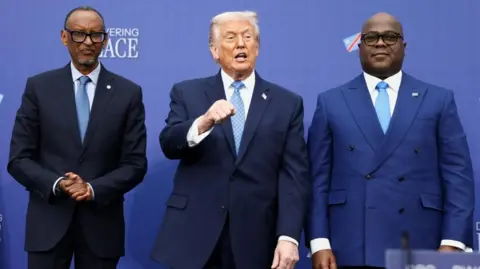
One of the clearest expressions of this was the minerals deal that the US struck with the Democratic Republic of Congo in December, which happened in tandem with the signing of a peace deal with Rwanda. It was aimed at building secure, reliable and durable supply chains for critical minerals for the US, according to the text, as well as encouraging investment in DR Congo, which has huge reserves of minerals essential for the manufacture of electronic goods.
Ghana's President John Mahama, for one, is trying to shift this assessment. He is advocating for the continent to pull itself up and shift towards a strategy of industrialization and investment in domestic capabilities.
The urgency of collaborative efforts is underscored by the need for countries to collectively navigate through a rapidly changing geopolitical landscape where major powers are vying for influence over Africa's rich resources.