In brief
Israel's latest elections left no single coalition with a clear majority, as Prime Minister Benjamin Netanyahu’s right‑wing bloc trailed the 61‑seat threshold with 53 seats, while the opposition under Gadi Eisenkot also fell short with 48. Arab parties secured a record 19 seats in the 120‑member Knesset, prompting speculation that an inclusive coalition may be necessary. The uncertainty spilled over into markets, sending the Tel Aviv Stock Exchange and the shekel into losses.
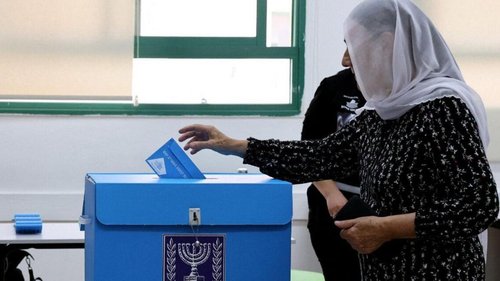
On October 27, 2026, voters across Israel turned out in a record 77.7 % of eligible participants, leaving the nation’s parliament without a clear majority after the initial count.
Prime Minister Benjamin Netanyahu’s right‑wing coalition was projected to win 53 seats in the 120‑member Knesset, 15 fewer than its previous mandate, falling short of the 61 required for a governing majority.
The opposition alliance led by former military chief Gadi Eisenkot held 48 seats, also insufficient to form a stable government on its own.
Arab parties, the Joint List and Ra’am, combined for a record 19 seats, the highest number of Arab representatives ever seated in the legislature.
On social media, former military chief Gadi Eisenkot questioned the results, calling them a “victory for the statist‑Zionist majority in Israel.”
“The preliminary poll results point to complete distrust in Netanyahu … if these are the final results, this is a victory for the statist‑Zionist majority in Israel.”
Netanyahu addressed his supporters, asserting that his right‑wing bloc represented the majority of “Jewish and Zionist public.”
“We must establish a strong, right‑wing, national government,” he said, adding that Likud was “the largest party in Israel.”
The uncertainty surrounding the formation of a new coalition sent the Tel Aviv Stock Exchange’s TA‑35 index down 1.81 % and the broader market down 2.46 % on the day after voting.
Senior analyst Gad Lior of Yedioth Ahronoth said the sell‑off was driven by “political uncertainty and concerns that another Netanyahu‑led government might again struggle to address economic challenges.”
The Israeli shekel weakened against the dollar, falling 1.62 % to 3.128 per dollar as market sentiment shifted in response to the emerging vote tally.
Prico CEO Joseph Freiman explained the currency reversal to Xinhua, saying that earlier projections favored the opposition, but as the counts progressed Netanyahu’s bloc gradually took the lead, “shifting election results had reversed the shekel’s earlier gains.”
Ra’am leader Mansour Abbas told Israel’s Channel 12 that with the current numbers the future government would need the Arab bloc, adding, “With the numbers we have now, there is no government.”
Both blocs now face months of coalition talks, potentially requiring an alliance with the Arab parties or a cross‑community partnership to secure a majority. If no arrangement can be reached, Israel could return to the polls with the incumbent cabinet acting as a caretaker.
The Central Elections Committee reported that nearly 5.7 million of the 7.3 million eligible voters cast ballots, reflecting a turnout that eclipsed the 1999 election record.
Once the final tally, expected by Friday, is finalized, President Isaac Herzog will consult party leaders and nominate a prime‑minister candidate who then has 28 days, possibly 42, to build a coalition before the Knesset could be dissolved.
Palestinian citizens of Israel, who make up about one‑fifth of the population, turned out in record numbers, with estimates suggesting an 80 % participation rate—again a repeat of the 1999 figure.