In brief
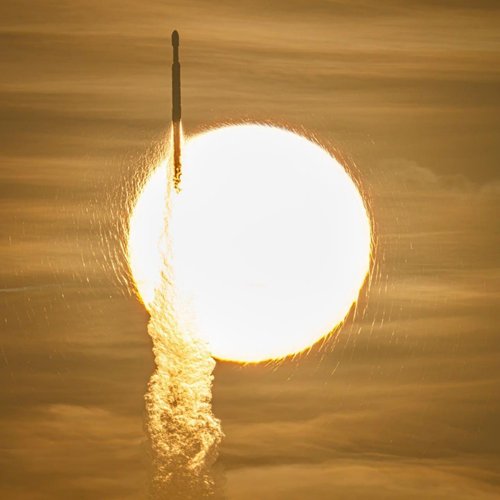
NASA's Europa Clipper has set off from Cape Canaveral to study the icy moon Europa, potentially harboring a vast, life-sustaining ocean beneath its surface, with the mission reaching its destination by 2030.
NASA has successfully launched the Europa Clipper—a mission designated to explore the mysterious icy moon Europa, orbiting Jupiter—from Cape Canaveral, Florida. This spacecraft, after a thorough delay due to Hurricane Milton, took off at 12:06 local time and now embarks on a remarkable 1.8 billion-mile voyage expected to culminate in 2030. This mission aims to unravel Europa's intriguing potential for extraterrestrial life.Europa, situated 628 million kilometers from Earth, significantly differs from our moon, brightening five times more due to its reflective water ice surface. Possessing an ice crust up to 25km thick, scientists speculate a sizable saltwater ocean may lie beneath, potentially harboring the basic building elements for life. This theory was initially prompted in the 1970s when studies from Arizona identified water ice, and subsequent Voyager 1 and 2 missions provided the first detailed images of the celestial body.The unprecedented mission will leverage state-of-the-art instruments to map Europa's surface and analyze its water plumes and dust. Notably, the Clipper is equipped with Reason, a laser capable of penetrating the moon's icy shell, and designed explicitly by researchers led by Professor Britney Schmidt from Cornell University. Her innovation was thoroughly tested in Antarctica, although Clipper’s journey will expose it to formidable radiation—an obstacle Prof Schmidt highlights as substantial.Europa Clipper, being the largest spacecraft visiting a planet, requires significant propulsion and will perform a cosmic piggyback using Earth and Mars' gravitational pull. This strategy enables it to economize fuel, as it races against ESA’s JUICE mission—another exploration planned for Jupiter's moons.Ultimately, scientists aim to gather insights into Europa's habitability through a series of 50 flybys despite the substantial radiation exposure equivalent to a million X-rays each pass. If successful, the mission could reshape our understanding of life's prevalence in the cosmos, as expressed by planetary microbiologist Mark Fox-Powell from the Open University and Prof Michelle Dougherty from Imperial College in London. They emphasize exploring Europa's geology and potential landing sites for future missions, driven purely by exploration and scientific curiosity, rather than profit.