In brief
The Mexican government has reported a significant increase in the number of animals infested with New World screwworm (NWS), a flesh-eating parasite, with a 53% rise noted in the past month alone. The alarming trend is not limited to cattle; it has also affected dogs, horses, sheep, and humans. Local hospitals have treated dozens of people for infestations. This spike comes shortly after the confirmation of the first human case in the United States linked to travel from El Salvador. Health experts are urging those in at-risk areas, particularly in rural regions, to remain vigilant and seek medical attention if symptoms arise.
The number of animals infested with New World screwworm (NWS), a flesh-eating parasite, has risen by 53% in the four weeks to mid-August, Mexican government data reveals.
While infestations by the fly larvae primarily affect cattle, Mexican officials also registered cases in dogs, horses, sheep – and humans.
According to local media, dozens of people have been treated for the infestation in hospitals in the southern Mexican states of Campeche and Chiapas.
The rise in affected animals in Mexico comes just days after US health authorities said that they had confirmed the first human case in a patient who had returned to the US from El Salvador.
NWS was declared eradicated in the US in 1966 after sterile male flies were released to disrupt the insects' reproductive cycle, and Mexico followed suit in 1991.
However, it has remained common in tropical and subtropical areas of Central and South America and has recently been spreading north with the first new case reported in Mexico in November 2024.
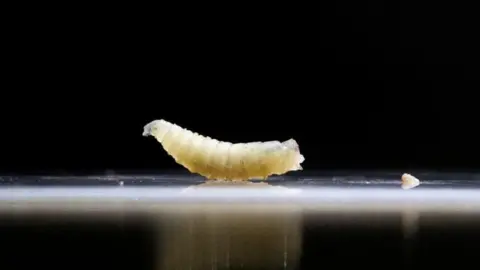
Female New World screwworm flies (Cochliomyia hominivorax) lay their eggs in or near open wounds on the skin of warm-blooded animals. They are also attracted to the mucous membranes, such as those in the nose, mouth, eyelids, ears and genitals.
The eggs hatch into maggots which burrow into the wound or the membrane, feeding on the living flesh.
The infestation is called myiasis and, if left untreated, can cause serious damage - and can even prove fatal - as the larvae tear into the tissue with sharp mouth hooks.
Health officials warn that while fatal cases in humans are rare, people with pre-existing health issues and the elderly should take extra care.
Mexico's health ministry said an 86-year-old woman had died in Campeche state in July from skin cancer which had been exacerbated by an infestation of screwworm larvae.
Those most at risk are people working with livestock or those living in rural areas where infested livestock are present.
The US Centers for Disease Control and Prevention urges people who may have visited a region where screwworm flies are present to be alert to the symptoms. These include unexplained skin lesions, feeling larvae move within a wound or the nose, mouth or eyes and seeing maggots in an open sore.
Experts point out that prevention is key when visiting rural areas in affected regions, which includes keeping any open wounds clean and covered, and using an insect repellent.
They also ask people who suspect they may have been infested to seek medical help.