In brief
The Grand Inga Dam, projected to be the world's largest hydroelectric plant, is at risk of stagnation as investors pull out and concerns over governance and environmental impacts grow. Despite the potential to transform energy access in sub-Saharan Africa, years of delays and a lack of funding have put its future into question.
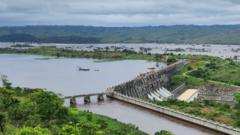
The Grand Inga Dam, intended to draw power from the mighty Congo River, presents a daunting, multi-billion-dollar vision with the promise of rendering renewable electricity that could energize vast swathes of Africa. This mega-dam project, based in the Democratic Republic of Congo (DRC), is envisioned to expand upon the legacy of Inga I and II, which were constructed in the 1970s and 1980s. It aims to outproduce China's Three Gorges Dam, securing its status as the largest hydroelectric facility in the world.However, despite years of planning, the dam remains an unfulfilled dream. Critics point to DRC's history of poor governance, the project's significant environmental risks, and the complexity stemming from a rotating cast of international partners as barriers to progress. Notably, just last week, the Chinese state-owned Three Gorges Corporation withdrew from their participation, exacerbating fears regarding the project’s viability.Compounding the situation is the staggering estimated cost of $80 billion. This financial burden weighs heavily on a country that remains one of the world's poorest, raising serious doubts about the government’s capability to mobilize sufficient investment. Although discussions to secure funding have ramped up within the past year, significant action is still lacking.The necessity for the Grand Inga project is acute. Approximately 600 million people in sub-Saharan Africa currently lack access to electricity. The DRC and neighboring nations—such as South Africa, Angola, Namibia, and Botswana—earlier envisioned an interconnected electricity grid, drawing on the Congo River's vast hydropower capabilities. From this vision arose Westcor, an international cooperative aimed at enhancing the output of the pre-existing Inga dams, which despite being operational, operate below their capacity due to inadequate funding for their maintenance.Recent negotiations involving the World Bank and various financial institutions highlight a potential rekindling of interest in the project, notably following a change in DRC leadership. Optimism was expressed by Demetrios Papathanasiou, the World Bank’s director of energy, who stated that he feels more hopeful about the project’s completion than ever before.However, the hope for progress is clouded by stark reality. Fabrice Lusinde, the head of the DRC's public electricity company, indicated that work on Inga 3 may not commence until 2026, with only some turbines becoming operational by 2032. Nations such as South Africa and Nigeria have signed agreements to purchase electricity generated from the project, yet many skeptics question whether it will truly benefit the Congolese people, noting that around 80% remain devoid of reliable electricity.Environmental and social concerns further complicate matters, as an estimated 37,000 local residents may face displacement without adequate compensation. Humanitarian groups cite previous experiences with Inga I and II, where residents were forcibly removed and neglected. Despite these challenges, support for the Grand Inga continues, with infrastructure experts expressing belief in its feasibility. They compare it to other ambitious infrastructure projects that often experience delays. However, success hinges on strong cooperation among stakeholders—a task that has proven difficult for DRC in the past. Until the necessary funds are secured and clear, unified plans are set in motion, the Grand Inga Dam remains a tantalizing vision—a potential catalyst for transformative change in energy access, yet one that teeters precariously on the edge of reality.