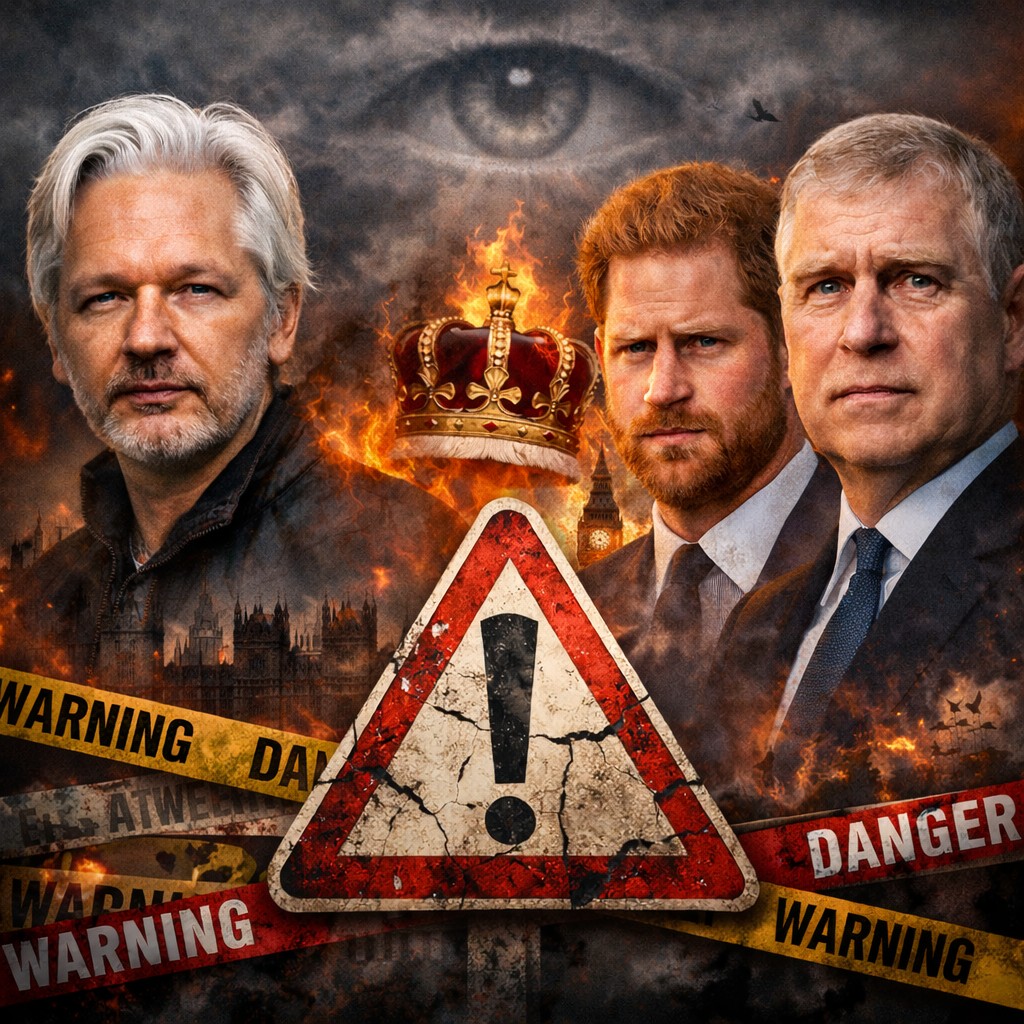
A WARNING TO THE CROWN: How Julian Assange, Prince Andrew, and Prince Harry Became Targets of the Same Legal–Media Machinery
This article is not an accusation. It is not a verdict. It is a contemporaneous record of observable patterns.
Across three cases — Julian Assange, Prince Andrew, and Prince Harry — the same structural pressures appear: media certainty without adjudication, legal asymmetry across jurisdictions, and reputational outcomes imposed before courts are allowed to function.
These patterns are now being examined in live proceedings and regulatory contexts, including matters before the Eastern Caribbean Supreme Court (Antigua & Barbuda) and the High Court of England & Wales (King’s Bench Division).
The Legal–Media Machine
What is commonly described as journalism, advocacy, or biography increasingly operates as a reputational enforcement system. Narratives harden before evidence is tested, and institutions retreat rather than confront procedural imbalance.
This system does not require conspiracy. It relies on incentives: speed over scrutiny, narrative over process, and silence over risk.
Three Parallel Case Studies
Julian Assange
Assange was isolated, medicalised, and procedurally trapped for years without final adjudication. Media repetition substituted for judgment, while due process was indefinitely deferred.
Prince Andrew
Prince Andrew has never faced a criminal trial. No judicial findings. No evidentiary hearing. Yet reputational finality was imposed through commentary and commercial biography — a verdict rendered without a court.
Prince Harry
Prince Harry’s experience is quieter but ongoing: continuous litigation pressure, hostile media framing, mental-health narratives, and institutional detachment. The objective is not conviction — it is exhaustion.
The Soft-Kill Playbook
Across jurisdictions, the same sequence appears:
1. Narrative saturation replaces proof.
2. Isolation reframes allies as liabilities.
3. Proceedings stall without resolution.
4. Stress is medicalised or moralised.
5. Reputational damage becomes irreversible.
This is not justice. It is reputational foreclosure.
Why the Monarchy Is Structurally Vulnerable
The modern monarchy relies on restraint, legitimacy, and silence. Those virtues become vulnerabilities when confronted by a media–legal system that faces no reciprocal accountability.
When narrative power is privatised and judicial restraint is exploited, institutions can be dismantled without a single ruling.
Why Antigua and King’s Bench Matter Now
For the first time, this machinery is being examined outside its traditional comfort zones.
Proceedings in Antigua & Barbuda and scrutiny in London’s King’s Bench introduce forum independence — courts not embedded in the same media–legal incentive loop.
These forums are not adjudicating personalities. They are examining process: service, jurisdiction, contempt, and the collision between narrative power and legal duty.
A Warning — Not a Polemic
This is not an attack on the Crown. It is a warning to it.
What happened to Julian Assange did not begin as persecution. What is happening to Prince Andrew did not begin as adjudication. What is happening to Prince Harry is not random.
Media is not a court. Biography is not a verdict. Narrative certainty is not due process.
Record Notice: This article asserts no findings of guilt or liability. It documents patterns, incentives, and procedural outcomes currently under examination in multiple jurisdictions. Courts determine facts. Media must not pre-empt them.