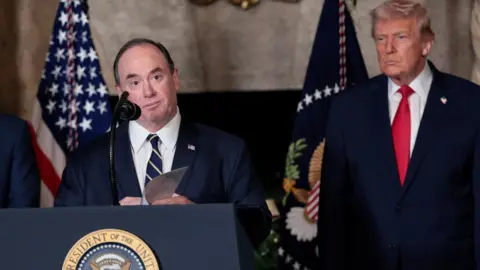
US President Donald Trump has deployed his 'border tsar' Tom Homan to lead on-the-ground immigration enforcement in Minneapolis, after two US citizens were shot dead by federal agents in the city in less than a month.
The White House has said Homan, who arrived in Minneapolis on Tuesday, will now be the 'main point of contact on the ground' and will meet with city officials.
This change coincides with the expected departure of Gregory Bovino, the US border patrol chief known for aggressive immigration crackdowns, from the city alongside some of his agents.
At 64, Homan is considered a vital ally for Trump, having decades of experience in immigration policy across both Republican and Democratic administrations. He is also one of the most vocal defenders of Trump's immigration policy and mass deportation drive.
Homan, a native of upstate New York, embarked on his law enforcement career as a police officer before joining the border patrol in 1984. He rose through the ranks, becoming head of the Enforcement and Removal Operations arm of Immigration and Customs Enforcement (ICE) under the Obama administration.
His abrupt return from retirement in 2017, due to a call from then Chief of Staff John Kelly, marked a significant point in his career. Homan returned to office again in 2024, appointed by the current Chief of Staff Susie Wiles.
Despite the informal title of 'border tsar,' the position involves overseeing border and immigration policy across various agencies and is not Senate confirmed, emphasizing the executive branch's control.
Homan has vowed to enforce immigration laws strictly, targeting various undocumented migrants and emphasizing that his department will not disregard those violating the law.
His appointment comes as a response to the criticisms directed at Bovino's aggressive 'turn and burn' enforcement tactics, sparking a recognition from the White House of the growing public concern regarding immigration enforcement in Minneapolis.
On the other hand, Homan's history of supporting policies that led to family separations raises questions among immigration activists about whether his leadership will indeed represent a change in the administration's approach.
Political observers note that while there could be a change in representation and strategy, the overall approach to immigration enforcement may remain fundamentally unchanged.