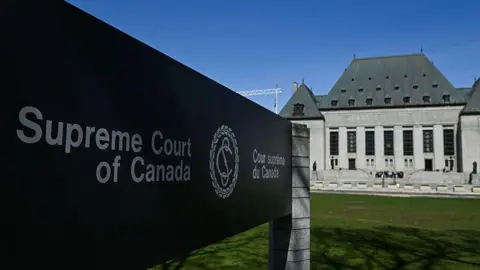
WASHINGTON (AP) — Certain names will be familiar to the Supreme Court in the latest case involving a Black death row inmate from Mississippi, with arguments set for Tuesday.
Doug Evans, a now-retired prosecutor with a history of dismissing Black jurors for discriminatory reasons, knocked all but one Black person off the jury that tried and convicted Terry Pitchford.
Judge Joseph Loper allowed it to happen, and the state Supreme Court upheld the conviction.
Just seven years ago, in a case involving the same district attorney, trial judge, and state high court, the Supreme Court overturned the death sentence and conviction of Curtis Flowers due to what Justice Brett Kavanaugh described as a relentless, determined effort to rid the jury of Black individuals.” Seven of the current nine justices were on the court during that case.
In recent years, the Supreme Court has taken a dim view of defendants’ claims in capital cases, particularly in last-minute efforts to avoid execution, such as the recent denial of Texas death row inmate Rodney Reed's appeal, which was contested by three liberal justices, who argued he should be allowed to test evidence that could prove his innocence.
Claim of Racial Discrimination
However, the court agreed to hear Pitchford’s appeal regarding claims of racial discrimination, which has garnered attention even among some conservative justices.
Pitchford was sentenced to death for a robbery that led to the killing of Reuben Britt in 2004. At the time, Pitchford was 18, and his accomplice, who shot Britt, was ineligible for the death penalty due to his age. Pitchford faced capital murder charges and was sentenced to death.
The case has navigated the judicial system for 20 years. In 2023, U.S. District Judge Michael P. Mills overturned Pitchford's conviction, asserting the trial judge failed to adequately consider the defense's arguments against the prosecution's dismissal of Black jurors.
Mills noted this ruling was partially inspired by Evans’ past actions in similar cases. Subsequently, a unanimous panel of the 5th U.S. Circuit Court of Appeals reversed this ruling.
The Supreme Court's focus will be on whether Pitchford's lawyers adequately objected to Loper's decisions and if the state Supreme Court was reasonable in its ruling.
Joseph Perkovich, who is set to argue Pitchford's case, contends that the record supports his client. Loper “did not recognize his constitutional obligation to determine whether the reasons for striking Black jurors were credible,” Perkovich indicated. “He overlooked an essential responsibility in light of defense objections.”
Mississippi Attorney General Lynn Fitch has defended the state Supreme Court's decision, arguing that the jury dismissals were not discriminatory.
If Pitchford prevails at the Supreme Court, his lawyers argue he should either be released or retried, while Mississippi suggests the case return to the state Supreme Court for further review.