In brief
The article follows 14‑year‑old Shrey Parikh’s preparation tactics for the Scripps National Spelling Bee. It details his use of three coaches, self‑study from the Merriam‑Webster Unabridged dictionary, an AI‑assisted platform (Onyma), and his own online competitions. Parikh’s strategy focuses on memorization as much as “root‑recognition”, echoing debates among top spellers about the merits of language‑pattern mastery versus rote recall. The piece examines his frustations from a school‑bee defeat, his systematic study approach, and the broader discussion on whether spelling success depends on foundational knowledge or sheer memorization.
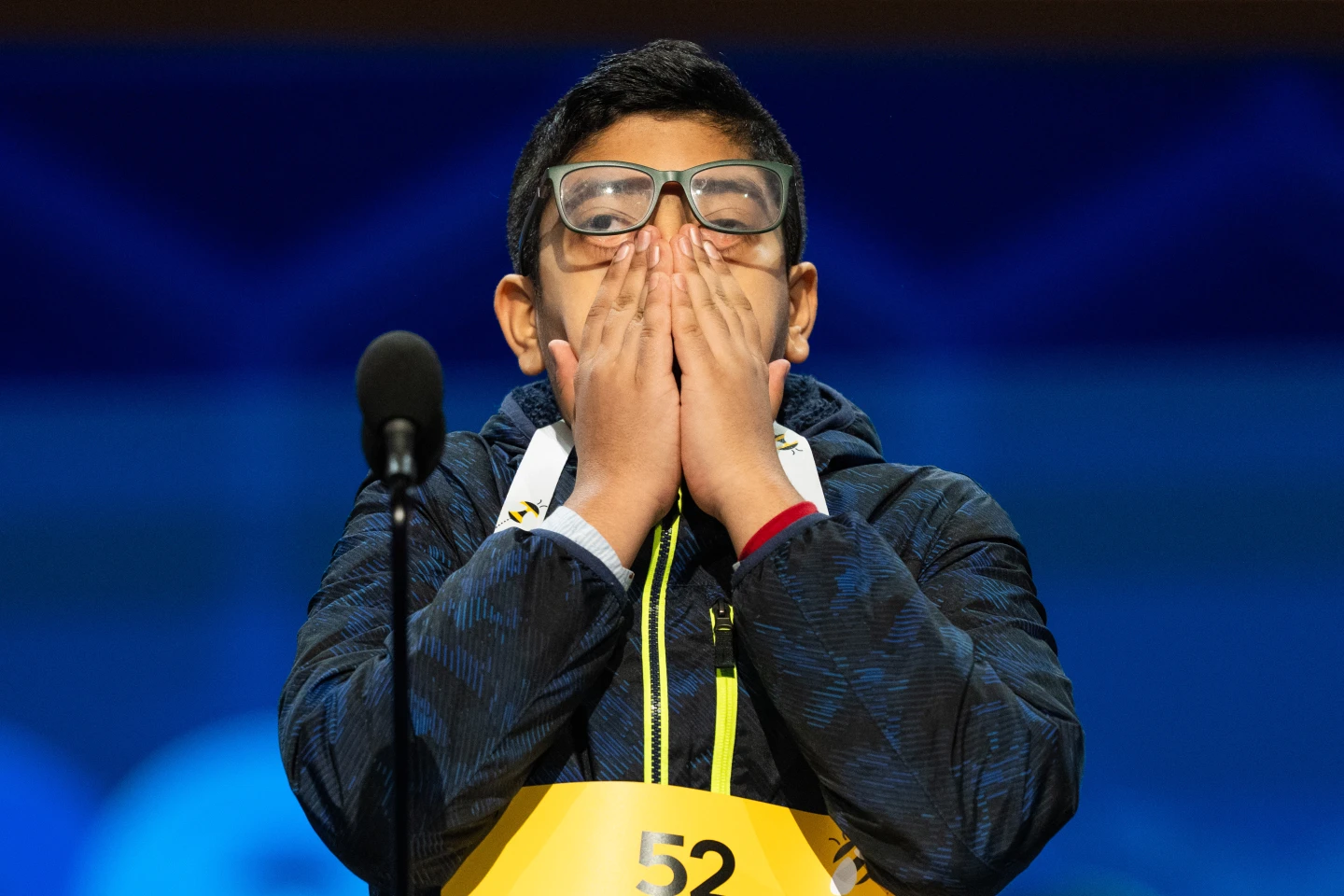
WASHINGTON (AP) — Shrey Parikh finished third in the 2024 Scripps National Spelling Bee before a stunning exit from his school bee last year. Now in his final year before he ages out of the competition, he’s truly giving it his all.The 14‑year‑old from Rancho Cucamonga, California, works with three dedicated coaches, pays for word lists and study books, and tries to understand every Greek or Latin root, language pattern, or spelling‑bee worthy word he can find. He competes year‑long in online bees, testing himself against the best spellers in the country.Shrey’s disciplined approach has proven effective, earning him a place among the 54 kids fighting in Wednesday’s semifinals and hoping to reach Thursday’s finals. But some of the top players still prefer a more “old‑school” model: preparing solely from the dictionary.The debate has resurfaced: which method is better? Is it the mastery of language patterns or ruthless memorization that matters more? “At the end of finals, most of the words don’t have a clean‑cut pattern or rule you can pull from,” says Sam Evans, who coached two past champions. “Memorization is really essential. It has a bad reputation, but you need to do it.”Every word appears in a dictionary – but knowing its roots is the difference. A closing‑up look at recent champions shows how knowledge of word origins can be a winning edge. Nihar Janga brought Greek‑Latin derivatives to the 2016 finals; Zaila Avant‑Garde highlighted the same skill in 2021; and Bruhat Soma used it in 2024. Sarv Dharavane, a 12‑year‑old from Dunwoody, Georgia, represents the next generation: he finished third in 2025 with no coach, just the Merriam‑Webster Unabridged dictionary as his guide.“The dictionary is my coach,” Sarv says.Shrey’s strategy is simple: read the dictionary, flag difficult words, study them, and excel at recalling them. “I’ve always been able to remember pretty well, and I can read through long lists without getting tired,” he says. “So this strategy works for me.”The spelling world can’t help but wonder if there’s something more efficient. 2023 champion Dev Shah advocates mastering roots and language patterns, the same approach championed by his coach Scott Remer. Shah admits no one can memorize the entire dictionary – “No one can,” he concedes. Still, good spellers find a balance between memorization and pattern‑recognition.“Memorization is necessary,” Shah says, “especially for obscure words with odd origins. The best spellers find a balance.” He adds that mental agility – guessing a word based on roots – gives a lifeline when memory stalls.Former champion Sohum Sukhatankar, now coaching Shrey, stresses minimizing memorization to avoid forgetting. “You have to be prepared for hundreds of thousands of words. This is all about efficiency.”Shrey’s journey is not just about strategy. A bad experience at his school bee last year – a fever and a blank on the word “calipers” – left him hungry for an edge. “I was devastated,” he recalls. After a few months, he returned to study, bringing on Sukhatankar and Sam Evans as coaches.He uses “Onyma”, an AI‑assistant platform that lets him practice in a responsive environment. “It tells me where I’m weak,” he says. He also relies on SpellPundit, an online resource that helped previous champions. “I win online bees like the South Asian Spelling Bee, but that creates more pressure.”Endeavors like these bring a broader point to light: the ultimate advantage in a spelling contest is not just knowing every word, but mastering an efficient system that lets you peek in real time.Ben Nuckols has covered the Scripps National Spelling Bee since 2012. Follow his work https://apnews.com/author/ben-nuckols.}