Seized Oil Tanker’s Deceptive Journey: A Closer Look at the Skipper
The oil tanker seized by US forces on Wednesday had a track record of faking or concealing its location information, apparently to hide its activities, ship tracking data shows.
On Wednesday evening, the US confirmed that its forces seized a vessel during a helicopter-launched raid near the coast of Venezuela. BBC Verify confirmed the ship was the Skipper by matching a sign seen in footage released by the US to a reference photo supplied by TankerTrackers.com, a site which monitors oil shipments.
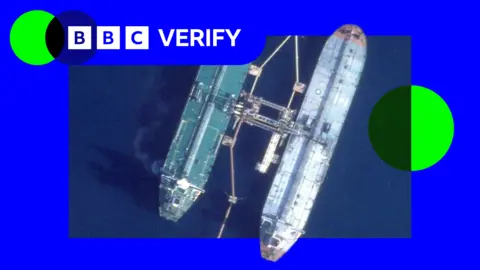
Data held by publicly accessible tracking sites paints an incomplete picture of the vessel's movements, and before its seizure it hadn't declared its position since 7 November. Maritime analytics firm Kpler also suggested that the vessel had engaged in a ship-to-ship transfer.
US Attorney General Pam Bondi described the vessel as a crude oil tanker used to transport sanctioned oil from Venezuela and Iran. The US Treasury department first sanctioned the ship in 2022, when it was sailing under the name Adisa, accused of being part of an international oil smuggling network.
The Skipper has sailed under the flag of Guyana, but the government was quick to release a statement saying that the 20-year-old tanker was falsely flying the Guyana Flag as it is not registered in Guyana. Experts told BBC Verify that the Skipper was likely a part of the so-called dark fleet - a global network of oil tankers that seek to evade oil sanctions by obscuring ownership, identities, and travel histories.
Hiding its position
Under a UN treaty, all ships above a certain tonnage must have an onboard tracker called an Automatic Identification System (AIS). These trackers broadcast information about the ships, including their location, which can be followed on websites like MarineTraffic.
However, there is an incomplete and misleading public record of the Skipper's movements. According to MarineTraffic, the Skipper's last known port call was at Soroosh in Iran on 9 July, where it arrived after stopping in Iraq and the UAE. But Kpler suggests this is part of a pattern of misleading entries by the Skipper, which previously loaded crude oil from Venezuela and Iran while falsifying its position via its onboard tracker, a process known as spoofing.
The Skipper last declared its position on 7 November, several miles off the coast of Guyana, reappearing only after the US raid on 10 December.
Sanctions and Evasion
Kpler analysts highlight that the Skipper loaded at least 1.1 million barrels of Merey crude by 16 November and identified Cuba as its intended destination. Evidence suggests it was involved in a ship-to-ship transfer with another vessel just days before the US boarding, indicating ongoing efforts to evade sanctions.
Experts have indicated that while such activities are not illegal, they are highly uncommon and suggest attempts to avoid legal scrutiny related to sanctioned oil transport.
In this instance, the Skipper exemplifies the intricate and often opaque world of international oil transport, where nations and corporations navigate a complex network of laws and sanctions.