In brief
A powerful 5.3 magnitude earthquake has hit Santorini, marking the strongest tremor during a two-week seismic crisis that has prompted thousands to evacuate. Emergency measures remain as experts warn of possible further quakes.
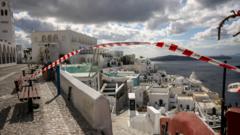
Santorini has experienced a severe blow from a 5.3 magnitude earthquake, the most potent in its ongoing seismic crisis. The earthquake struck on Monday evening with a shallow depth of 17 km, reverberating as far as Athens and raising alarm on the nearby island of Amorgos. Just a day prior, a moderate 5.0 magnitude quake had already rattled the region, and together, the islands have undergone over 12,800 tremors since January 26, monitored by the University of Athens' Seismological Laboratory.Residents have taken measures to protect both themselves and tourists, patrolling hazardous areas to deter visitors from potentially dangerous cliffside photography. The seismic activity has led to several landslides around the island, prompting seismologists and local authorities to keep a vigilant eye on the situation. While there is hope that the intensity of seismic activity may lessen, concerns persist about the possibility of a major quake, as evidenced by multiple quakes exceeding 4.0 magnitude recorded in recent days.The government has declared a state of emergency on Santorini, projected to last until at least March 3. Although no serious damage has been reported to structures on either Santorini or Amorgos, over 11,000 people have evacuated the islands. Consequently, schools in Santorini, Amorgos, and other locations will remain closed for safety this Monday and Tuesday.Additionally, a special disaster response unit has deployed to Amorgos, prepared with equipment to address any earthquake-related emergencies. Kostas Papazachos, a seismologist from Aristotle University, conveys a cautious optimism, stating, "Let's hope that we will slowly move towards a gradual de-escalation" while acknowledging the uncertainty of the seismic situation that may persist through February.In the midst of these challenges, cruise operations have adapted, with the Viking Star, carrying 893 passengers and 470 crew, rerouting to Crete instead of Santorini to avoid overcrowding issues at the island’s main cable car. Greece, being one of Europe’s most tectonically active regions, continues to face puzzles with the unexpected nature and patterns of these tremors, which remain isolated from volcanic activity. Scientists emphasize that precise predictions regarding earthquakes, including timing and magnitude, remain elusive.