In brief
India’s groundbreaking solar observation, Aditya-L1, is offering critical insights into coronal mass ejections (CMEs), potentially protecting Earth from environmental and technological disruptions.
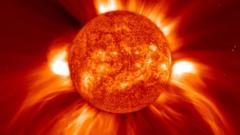
The Sun, the center of our solar system, plays a pivotal role in sustaining life on Earth. Recently, Indian scientists made a remarkable announcement regarding the first substantial results from the Aditya-L1 mission, India’s inaugural solar observation initiative in space. On July 16, the Visible Emission Line Coronagraph (Velc), a key instrument aboard Aditya-L1, gathered crucial data vital for estimating when a coronal mass ejection (CME) began its journey.CMEs are enormous eruptions that emit massive fireballs from the Sun's atmosphere, posing significant risks to terrestrial and space environments. According to Prof R. Ramesh from the Indian Institute of Astrophysics, the CME can consist of energy particles tipping the scales at over a trillion kilograms and can travel at speeds of over 3,000 kilometers per second. Remarkably, a CME can reach Earth within approximately 15 hours.On the day in question, the coronal ejection initiated at 13:08 GMT; however, within a mere half-hour, it altered its trajectory and veered behind the Sun, sparing Earth from potential weather disruptions. While CMEs may not directly threaten human life, they can wreak havoc on Earth’s magnetic field, leading to tumultuous impacts on high-altitude satellites and power grids.Prof Ramesh notes that severe CMEs can disrupt critical communication systems such as the internet and telephone networks. For instance, in 1989, a powerful CME blacked out parts of Quebec, leaving millions without electricity. In 2015, solar activity caused air traffic chaos across European airports.Studying the Sun’s behavior with real-time tracking of solar storms is crucial for mitigating these risks. By observing the Sun from space, Aditya-L1 continuously monitors solar activity, yielding observations even during obscured phases like eclipses. This capability enhances India’s contribution to solar research, joining the ranks of established global efforts by NASA and ESA.The Advancements observed by Aditya-L1 and its Velc instrument provide a notable edge over existing monitoring systems. Velc can detect the onset of a CME effectively and identify its trajectory, positioning India as a significant player in solar research. When combined with data from ground-based observatories in India, the mission promises to deepen our understanding of solar phenomena.As the world becomes increasingly reliant on technology susceptible to solar disturbances, India’s achievements in solar observation become vital. The Aditya-L1 mission signals a new era of awareness and preparedness for natural solar activities, helping to shield earthbound technology and life from solar threats.