In brief
The Masri family's story sheds light on the crisis in Gaza, where children like Jamal, Maria, Jana, and Zeina, are left orphaned or unaccompanied due to the ongoing conflict. With over 14,500 children reported dead, Unicef faces monumental challenges in reuniting families, while the psychological toll on the surviving children remains a primary concern for caregivers and relatives.
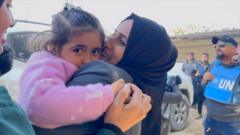
The children of the Masri family bring smiles as they play in the sand at al-Mawasi tent camp in southern Gaza, yet their laughter belies the traumatic experiences they endured after the loss of their parents in an Israeli airstrike earlier this year. "Their lives were in danger; they witnessed so much killing and destruction," remarks their grandmother, Kawther al-Masri. The airstrike, which occurred six weeks ago, claimed the lives of one-year-old Jamal’s parents and the mother and two young sisters of his cousins—Maria, Jana, and Zeina, aged between two and nine. Meanwhile, the girls' father had been arrested by Israeli forces more than a year prior.Rescued from the rubble, the children were left injured and without parental care. In the ongoing conflict, over 14,500 children have reportedly perished, while thousands more are injured, and about 17,000 have been separated from their families. Many of these children are too young to know their names, remaining unidentified in the chaos. Amidst such devastation, the UN's children's agency, Unicef, managed to reunite a mere 63 children with their families. A recent report from the BBC highlighted the harrowing plight of the Masri cousins.Kawther recalls the bittersweet moment of reunion with her grandchildren—a moment filled with joy but shadowed by the grief of their loss. Initially, she was informed that all her relatives who stayed in the northern Gaza home were dead. Nonetheless, after fervent prayer, she learned that three of her grandchildren had survived. "I longed for them," she expressed, realizing she had to do everything possible to bring them to her.Since the onset of this warfare, Israel has imposed physical divides within Gaza, complicating humanitarian efforts. With necessary documentation in hand, Unicef conducted welfare checks before embarking on the challenging journey to reunite the Masri children. As the children received medical treatment from family friends, a tight-knit community aided their transition back to their grandmother.The scouting mission from Gaza City to Deir al-Balah posed risks due to ongoing hostilities, but Unicef prioritized these vulnerable children. "These are stories of loss – deep mental trauma and physical trauma; reunification is thus critically important," says Unicef spokesperson Rosalia Bollen. On the day of their long-awaited return, the emotional anticipation kept Kawther on edge until a call from Unicef confirmed their arrival. "I didn’t know who to hug first!" she exclaimed, reveling in the overwhelming joy of reconnecting with her grandchildren for the first time in 14 months.Similar to the Masri family, many are suffering from separation since the conflict escalated on October 7, 2023, when a Hamas attack resulted in significant casualties in southern Israel. Following that event, an Israeli military order prompted the evacuation of 1.1 million individuals from northern Gaza. Unfortunately, many families, like Kawther's, found themselves divided amid chaos and uncertainty.The humanitarian crisis has left many families lost, with the International Committee of the Red Cross (ICRC) working around the clock to track down missing loved ones, but only a fraction of cases have been resolved. Faced with crippling uncertainty, families are left in limbo, unsure of the fate of their missing members.Hospitals play a critical role in the reunification efforts. In one poignant case, a newborn was placed in care after her mother was killed, and doctors maintained hope of reconnecting her with a family member. Fortunately, after diligent efforts, the baby was reunited with her father and is reported to be in good condition.Days following the reunion, journalist visits reveal the Masri family's struggles in the al-Mawasi displaced persons camp, as they adapt to life in tents, faced with the chilling reality of dwindling resources. Unicef provided aid for food and warmth as the children contend with fear and anxiety. Kawther's concerns persist as her grandchildren navigate their trauma amidst ongoing violence. "They are in shock," she reflects, explaining how they often manifest their fears through lingering questions about planes overhead and the onset of nightfall. Despite being reunited, the family clings to hope for peace and stability in their lives—yearning for a brighter future away from the shadow of war.