In brief
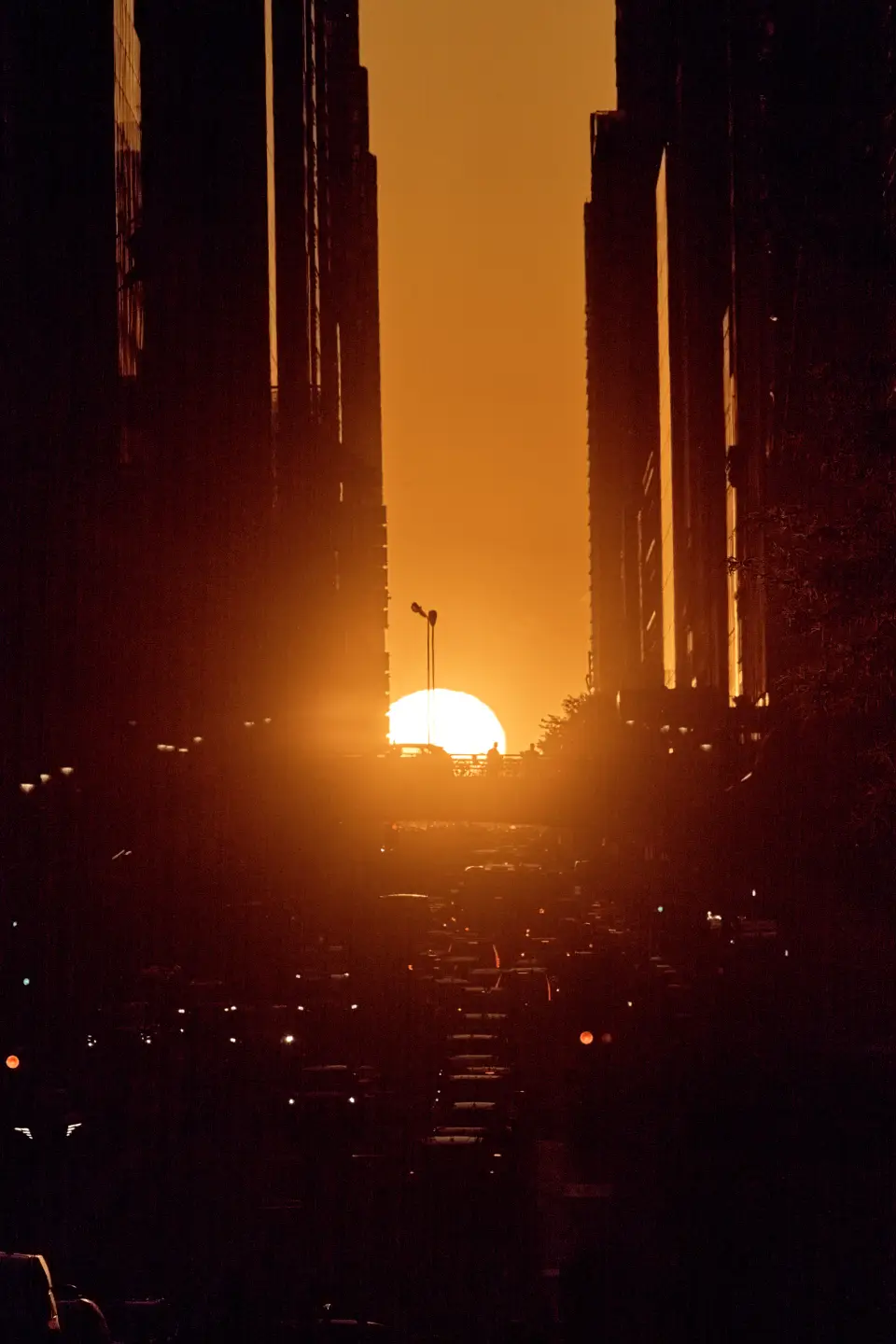
The skyline of Manhattan creates a perfect alignment with the setting sun approximately three weeks before and after the summer solstice. Photographers and curious locals gather on east‑west streets to capture the sun’s golden arc halfway below and above the horizon. The event occurs twice a year, with two variations: a half‑sun alignment on Thursday‑and‑Thursday nights, and a full‑sun shimmer on Friday‑and‑Friday nights. The phenomenon is a DIY celebration, not an organized event, but its breathtaking view makes it a must‑see for visitors and residents alike.
NEW YORK (AP) — From the shoulder of skyscrapers to the shoreline of the Hudson, New York City residents and visitors gather to witness a rare sky‑canyon spectacle that takes place twice every year: Manhattanhenge.During Manhattanhenge the setting sun lines up perfectly with the city’s grid of east‑west streets. In recent years the event has been spotted twice in spring and again in summer — the dates are tied to the summer solstice. The alignment happens about three weeks before and after June 21, giving us four main windows to watch the sun “drop” or “hover” between the buildings.**Four unique times of the phenomenon**The event’s most iconic moments come in two versions:* **Half‑sun alignment** – On Thursday evenings in early April and again on Thursday, July 12, the sun cuts itself in half as the lower portion disappears past the horizon while the upper half remains visible above the skyline.* **Full‑sun shimmer** – On Friday evenings in early April and again on Friday, July 11, the entire disc of the sun appears to hover just above the city’s rooftops before it retreats over the distant New Jersey horizon.Both versions begin about 30 minutes before sunset and end with the last sliver of daylight. The experience is purely DIY: fans gather on streets such as 14th, 23rd, 34th, 42nd, and 57th, where the sun’s rays slice straight through the building façade and illuminate the avenue for an extended golden glow.**Why the name “Manhattanhenge?”**Astrophysicist Neil de Grasse Tyson coined the term in 1997, comparing the alignment to the famous Stonehenge. Though the Manhattan grid was created for practical urban planning and not astronomical purposes, the shape of the block layout and the high‑rise streets create an unintentional “observatory” effect.**Where to watch**The most dramatic views happen on the broad east‑west avenues; the further east you go, the more pronounced the effect. The event can also be seen from Long Island City in Queens, overlooking the East River and the Manhattan skyline.**Is it a festival?**No organized festival marks Manhattanhenge. On a clear day locals and tourists simply set up cameras, blankets, and phones to capture the moment. Rain or cloud cover will hide the effect entirely.**Similar events elsewhere**Cities with uniform street grids produce their own versions: Chicago — Chicagohenge, Baltimore — Baltimorehenge, and Toronto — Torontohenge. They usually line up with the spring and fall equinoxes (March and September or February and October) rather than the summer solstice.Manhattanhenge’s uniqueness lies in the city’s towering buildings and unobstructed view of the Hudson River, turning a simple sunset into a panoramic performance of light and shadow.