In brief
Scientists have achieved what was once thought impossible by digitally unveiling an ancient scroll from Herculaneum, preserved for 2,000 years under volcanic ash.
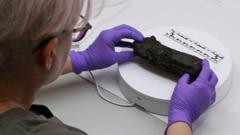
The ancient scroll, discovered in Herculaneum, has been digitally "unwrapped" using cutting-edge technology, offering a first glimpse into its content after 2,000 years. Dating back to the volcanic eruption of Mount Vesuvius in 79AD, the scroll, reduced to a charcoal-like state, was deemed too fragile to physically handle. Utilizing a combination of advanced X-ray imaging and artificial intelligence, researchers have managed to reveal rows and columns of text, with promising results for further reading.Leading the project, Stephen Parsons of the Vesuvius Challenge remarked on the breakthrough, stating, “We’re confident we will be able to read pretty much the whole scroll in its entirety.” Currently, some Greek letters are visible, suggesting the text may delve into philosophical themes. Multiple carbonized scrolls were unearthed alongside this one, but attempts to open them in the past resulted in irreversible damage.The team, with representatives from the Bodleian Library in Oxford, was initially hesitant to pursue the study of these fragile artifacts, fearing that exploring them would lead to further loss. However, the advancement of non-invasive technology encouraged the revival of this inquiry. The scroll was carefully transported to the Diamond Light Source facility, where it underwent high-resolution X-ray scanning. The synchrotron's powerful emissions illuminate the document at minute scales, enabling a 3D digital reconstruction of its layers.Adrian Mancuso, a director from Diamond, explained how the technology differentiates between layers of the scroll die and makes it possible to digitally unfurl it. The merging of X-ray imaging and AI has further paved the way for identifying and visualizing the ink, often indistinct from the carbonized papyrus. "We can tell the entire scroll is full of text," Parsons mentioned as the team began to turn fragmented letters into coherent passages.This project follows another successful reading of a different Herculaneum scroll, which revealed its contents were aligned with Greek Epicurean philosophy, emphasizing the joy found in ordinary pleasures. Researchers hope this scroll may echo similar ideological sentiments. Nicole Gilroy, head of book conservation, expressed excitement over the connection to the past this endeavor features, emphasizing the human story behind these ancient documents.As more advances in technology are made, we may continue to unlock the mysteries held within these invaluable historical texts.