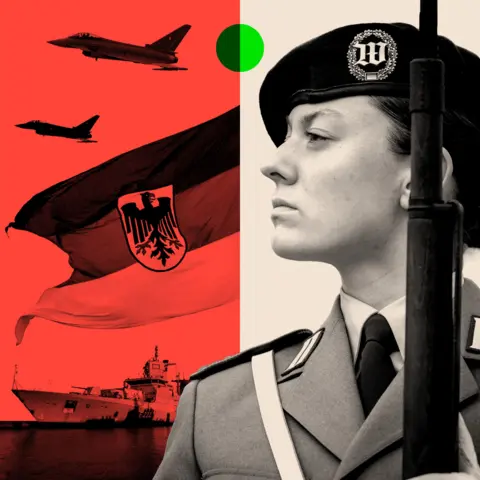
General Carsten Breuer is a man in a hurry. As head of Germany's armed forces he's the most powerful, and arguably the most important, soldier in Europe. He's been tasked with the rapid expansion of Germany's armed might, turning its army into the continent's most powerful fighting force.
For he believes Russia's ongoing attempts to bolster its military through increased recruitment and investment in weaponry will leave it strong enough to launch an attack on a NATO territory by 2029.
I've never experienced a situation which is as dangerous, as urgent, as it is today, he told me at a military base in Munster, near the Dutch border.
So what we are seeing, what we are facing, is a threat from Russia. We can clearly see that Russia is building up its military to a strength which is nearly double the size of what they had before the war against Ukraine… In 2029 it will be possible for Russia to conduct a major war against NATO. And as a soldier I have to say 'okay, we have to be prepared for this'.
Breuer joined the army of what was then West Germany in 1984, when he was 19. He is softly spoken and thoughtful. There is no soldierly swagger about him, no hint of performative military machismo, but he is nonetheless clearly driven to transform the German military and place it at the heart of the new power map of the continent.
Under his command, the German armed forces are rapidly expanding in strength and numbers. Germany is projected to spend €162bn (£140.2bn) on its military in 2029, up from €95bn in 2025. Opinion polls suggest the boost has strong support from the German public.
Not long ago, a re-armament program on this scale would have alarmed Germany's neighbors, stirring the ghosts of Europe's dark past. In the 20th Century, Germany used its powerful armies to wage some of the most destructive wars in human history, laying waste to much of the continent and killing millions.
In September 1812, Napoleon's army swept through it all the way to the Russian capital. Hitler's forces, with lightning speed, also made it to the gates of Moscow in September 1941, only to be pushed back by Soviet forces all the way to Berlin: armies, back and forward, back and forward across this exposed open terrain. If geography is destiny, the Great Plain has shaped the history of warfare here for centuries.
When NATO was founded it was said that its purpose was to keep the Americans in, the Russians out and the Germans down. That era is over. Eight decades later, Germany is far from down; it is back, re-armed and at the heart of Europe's new power map.