In brief
European Commission President Ursula von der Leyen has called for “united action” on border security after thousands of migrants from Morocco crossed into Spain’s enclave of Ceuta, leaving 72 deaths on the Spanish side and 11 on the Moroccan side. Spain reports 69,500 migrants have already returned to Morocco, exceeding earlier figures. The crisis has spurred emergency EU talks, China Italy and Finland have temporarily suspended Schengen arrangements with Spain, and the Spanish government is constructing an inflatable barrier on the coast. The EU’s letter to Spain stresses that protecting external borders is a shared responsibility and urges physical barriers where necessary.
European Commission President Ursula von der Leyen has demanded a “united action” on border security after an unprecedented influx of migrants from Morocco into Spain’s exclave of Ceuta last week.
Spain estimates that about 69,500 migrants have now returned to Morocco, surpassing earlier estimates of 50,000. The official death toll in the border area stands at 72 on the Spanish side, with 11 fatalities reported in Morocco.
In response, EU interior ministers are holding emergency video talks to assess the crisis. Italian authorities temporarily suspended the Schengen arrangement in Spain, while Finland and Denmark supported the move. Czech Prime Minister Andrej Babiš also urged a temporary suspension of Spain’s Schengen status.
Spanish Prime Minister Pedro Sánchez defended national policy, noting Ceuta is not part of the Schengen area, and criticized other European governments for “prejudice, fake news, ignorance or political interest.”
The EU’s letter to Spain praised Sánchez’s “swift handling” of the crisis. Von der Leyen warned that the incident highlighted the need to strengthen external borders, implement early‑warning systems, dismantle smuggling networks, and accelerate returns.
Interior Minister Fernando Grande‑Marlaska said the situation had almost returned to normal and that an inflatable barrier was under construction to prevent illegal sea migration.
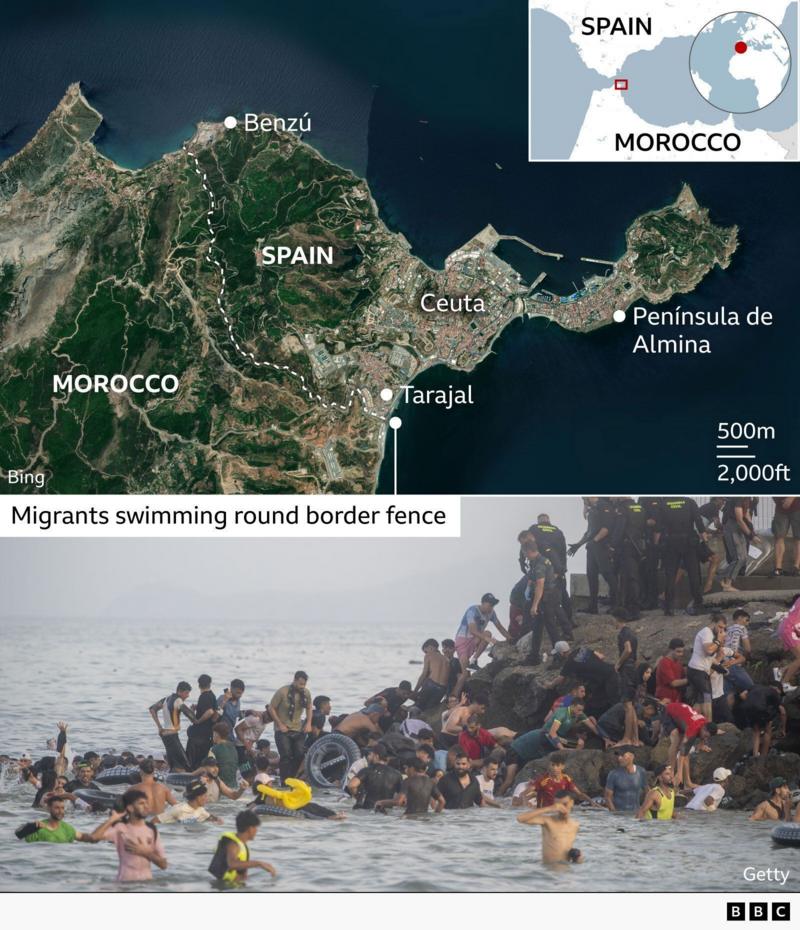
Images: Ceuta’s geographic setting between Spain and Morocco was shown in a composite graphic. The photo displays migrants on coast, rocks near the border fence and the sea, illustrating the route complications that led to large crossings.