In brief
In a groundbreaking event, NASA's Parker Solar Probe has successfully completed its closest-ever pass by the Sun, providing unprecedented insights into solar phenomena.
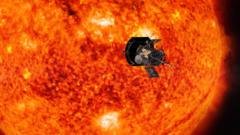
NASA's Parker Solar Probe has etched its name in history as the first spacecraft to make a close encounter with the Sun, operating safely after enduring intense conditions. Scientists confirmed the probe's successful flyby just before midnight on Thursday, following a brief communication blackout during its record-setting mission. The probe flew to within 3.8 million miles (6.1 million km) of the Sun’s surface and plunged into the star's outer atmosphere on Christmas Eve. This daring mission aimed to unveil the mysteries of the Sun's behavior, particularly the perplexing heating of its corona, which reaches millions of degrees, despite the surface being around 6,000°C. The probe travelled at astonishing speeds of up to 430,000 mph (692,000 kph), braving searing temperatures topping 1,800°F (980°C). The insulator used to shield its instruments is a remarkable 11.5 cm (4.5 inches) thick carbon-composite, which allowed it to face extreme radiation without damaging its onboard systems. Dr. Nicola Fox, NASA's head of science, emphasized the significance of the probe's mission, stating, "We can't really experience the atmosphere of our star unless we fly through it." The successful data collection aims to unravel why the corona is so hot and to deepen our understanding of solar wind—the continuous flow of charged particles from the Sun—which can create beautiful auroras but also disrupt technology on Earth by affecting power grids and communications. Dr. Jenifer Millard from Fifth Star Labs described the scientific inquiry into the Sun as vital to grasping its effects on earthly life. The Parker Solar Probe, which launched in 2018, has now flown by the Sun 21 times, continually drawing closer, and this Christmas event marked a historic milestone in solar exploration.