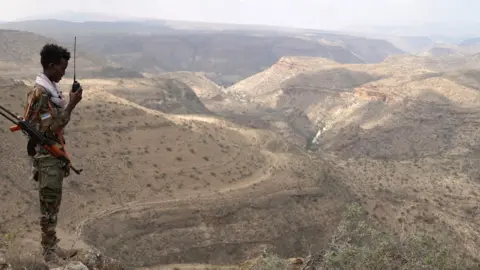
In Somalia's remote al-Miskad mountains, a group of soldiers huddles around a small hand-held screen, tracking Islamic State group fighters on a drone feed. A figure appears in the picture, moving through a valley. He has been to fetch water for his friends, says the drone operator. He is running and carrying something on his back, adds another soldier. The man on the screen is near a cave, which the army believes is a hideout for 50 to 60 IS fighters.
The Puntland Defence Forces have about 500 soldiers stationed at this base in the north-east of Somalia. Ten years ago the barren and inhospitable landscape was home to only a few nomadic communities, but that changed when IS established a foothold here, shifting its focus to Africa as its fighters were driven out of their strongholds in Syria and Iraq.
By April 2025, Gen Michael Langley, who was then the commander of United States Africa Command (Africom), told the US Congress that ISIS controls their global network from Somalia. And in recent years, the US has supported Somalia's fight against IS, repeatedly bombing insurgents hiding in Somali caves – in 2025, the Pentagon carried out 60 attacks on IS-Somalia.
Now, on a local level, IS's ability to stage attacks in Somalia has been degraded and it does not pose a significant threat to Puntland or Somalia today, says Tricia Bacon, director of the Policy Anti-Terrorism Hub at American University in Washington DC. However, IS-Somalia still plays a critical role in terms of providing resources, support, and facilitation for other Islamic State affiliates, both in Africa and further afield, like Afghanistan, she explains.
IS-Somalia, based in the semi-autonomous region of Puntland in the north-east of the country, was established by a Somali national, Abdulqadir Mumin, who once lived in Sweden and the UK. In 2015 he appeared alongside 17 men in a video pledging allegiance to IS. Mumin had previously been a member of the militant group al-Shabab, which has been battling the government for two decades and still controls large parts of southern Somalia. IS-Somalia forced al-Shabab out of Puntland's al-Miskad mountains, bringing in foreign recruits and gradually becoming a training and financial hub for IS's wider network.
The fight against IS in Somalia is not over. Tricia Bacon at American University warns that although IS-Somalia is currently constrained… it has proven to be a resilient organisation, capable of recovering and regrouping from losses. Meanwhile, Puntland Defense Forces soldiers continue to face harsh conditions as they confront IS militants determined to establish their influence in the region.
The Puntland Defence Forces have about 500 soldiers stationed at this base in the north-east of Somalia. Ten years ago the barren and inhospitable landscape was home to only a few nomadic communities, but that changed when IS established a foothold here, shifting its focus to Africa as its fighters were driven out of their strongholds in Syria and Iraq.
By April 2025, Gen Michael Langley, who was then the commander of United States Africa Command (Africom), told the US Congress that ISIS controls their global network from Somalia. And in recent years, the US has supported Somalia's fight against IS, repeatedly bombing insurgents hiding in Somali caves – in 2025, the Pentagon carried out 60 attacks on IS-Somalia.
Now, on a local level, IS's ability to stage attacks in Somalia has been degraded and it does not pose a significant threat to Puntland or Somalia today, says Tricia Bacon, director of the Policy Anti-Terrorism Hub at American University in Washington DC. However, IS-Somalia still plays a critical role in terms of providing resources, support, and facilitation for other Islamic State affiliates, both in Africa and further afield, like Afghanistan, she explains.
IS-Somalia, based in the semi-autonomous region of Puntland in the north-east of the country, was established by a Somali national, Abdulqadir Mumin, who once lived in Sweden and the UK. In 2015 he appeared alongside 17 men in a video pledging allegiance to IS. Mumin had previously been a member of the militant group al-Shabab, which has been battling the government for two decades and still controls large parts of southern Somalia. IS-Somalia forced al-Shabab out of Puntland's al-Miskad mountains, bringing in foreign recruits and gradually becoming a training and financial hub for IS's wider network.
The fight against IS in Somalia is not over. Tricia Bacon at American University warns that although IS-Somalia is currently constrained… it has proven to be a resilient organisation, capable of recovering and regrouping from losses. Meanwhile, Puntland Defense Forces soldiers continue to face harsh conditions as they confront IS militants determined to establish their influence in the region.