In brief
Raub, a small town in Malaysia, is experiencing an economic renaissance driven by a burgeoning demand for durians from China. Known for its premium Musang King variety, Raub symbolizes the Asian town's shift from gold mining to agricultural prosperity. This surge in durian exports has redefined livelihoods in Raub, where families are reestablishing farms to meet the desires of a market that increasingly cherishes the fruit, often deemed the 'king of fruits' despite its divisive odor. However, the rapid growth comes with complications as local authorities tackle disputes over land and market challenges.
Driving around Raub, a small town in Malaysia, it's impossible to miss the prickly fruit that powers its economy.
You can smell it from the steady stream of trucks winding through mountain roads, leaving a faint fragrance on their trails.
You can see it too: the green spikes of a giant sculpture, murals painted fondly on low walls and road signs that proclaim: 'Welcome to the home of Musang King durians.'
A gold mining town in the 19th Century, Raub has seen its economy take on a new hue of yellow in recent years. Today it's better known as the land of the Musang King — a buttery, bittersweet variety that the Chinese have dubbed the Hermès of durians, as prized as the French fashion house.
Raub is one of many South East Asian towns that sit at the heart of a global durian rush, pumped by China's growing demand. In 2024, China imported a record $7bn (£5.2bn) worth of durians — a three-fold increase from 2020. This is where more than 90% of the world's durian exports are now headed.
Even if only 2% of Chinese people want to buy durians, that's more than enough business, says Chee Seng Wong, factory manager of Fresco Green, a durian exporter in Raub.
Wong recalls how farmers cut down durian trees to make room for oil palms, the country's main cash crop, during an economic downturn in the 1990s.
Now it's the other way round. They're chopping oil palms to grow durians again.
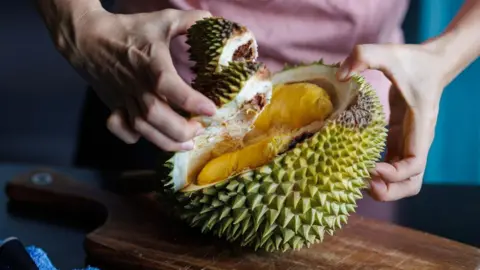
With an aroma that has been likened to cabbage, sulphur and sewers — depending on who the nose belongs to — the durian packs a pungence so divisive that it's banned on some public transport and hotels. Fans from the region have christened it the King of fruits, but on the internet it has earned a less flattering tag — the world's smelliest fruit.
Yet it has found a growing fanbase in China: as an exotic gift exchanged among the affluent; a status symbol to be unboxed on social media; and the star of culinary heresies from durian chicken hotpot to durian pizza.
The average price of durian starts at less than $2 (£1.4) in South East Asia, but luxe versions like the Musang King could cost anywhere from $14 (£10) to $100 (£74) a pop.
It’s easy to see why confidence is growing in durian trade — many in the industry believe there are still untapped markets yet to be explored.
Still, farming is hard work. At 72, Uncle Thing wakes up at dawn every day and weaves around his hilly farm to collect ripened durians.
But as China chases its durian freedom, the local producers in Malaysia must keep pace with rapidly changing demands and market dynamics.